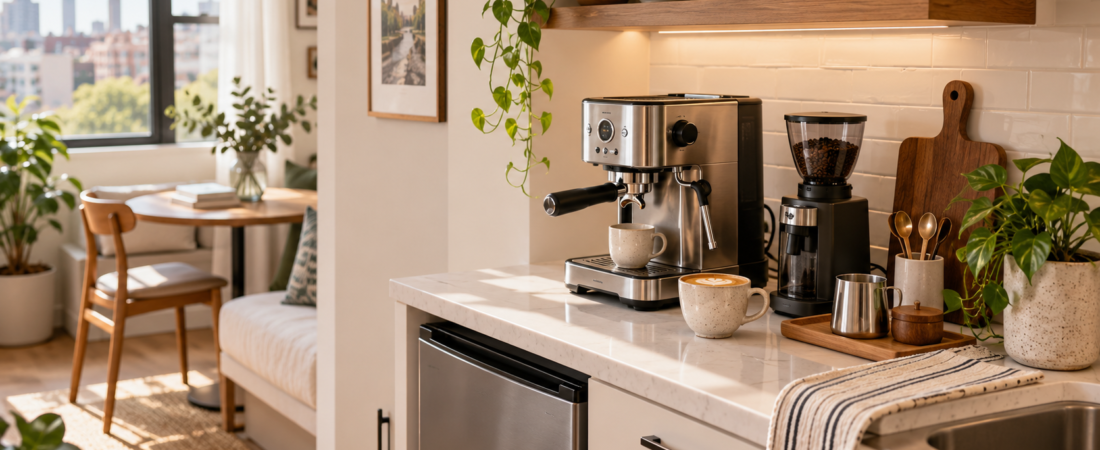
When setting up a compact espresso machine in a small kitchen or apartment, counter space is usually the biggest hurdle. Standard appliance reviews evaluate coffee gear on wide, open countertops. In a compact kitchen, however, every centimetre counts.
Choosing the right compact home espresso machine requires looking beyond advertised chassis widths. To build an efficient setup that doesn’t crowd your cooking space, you need to consider your full setup footprint—accounting for portafilter clearance, steam wand movement, cabinet access, grinder placement, and daily cleanup.
1. Quick Picks: How Much Counter Space Do You Really Need?
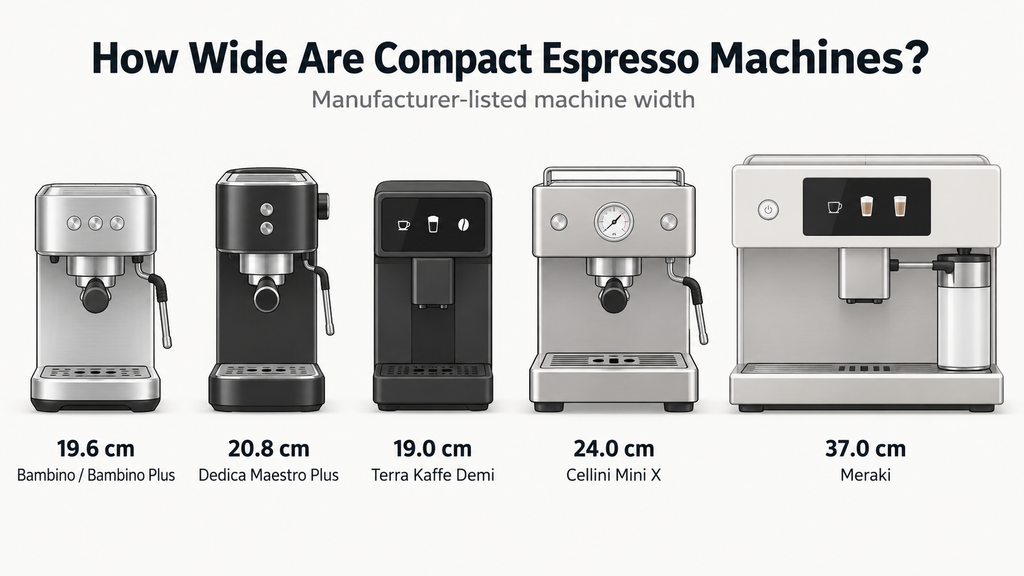
To help you evaluate which machine fits your kitchen, the table below compares manufacturer dimensions against the estimated setup width required once you add essential preparation tools and working clearance.
| Machine | Machine Dimensions (W × D × H) | Estimated Setup Width* | Grinder Needed? | Water Access | Extra Side Space? | Best Small-Space Use |
|---|---|---|---|---|---|---|
| Breville Bambino | 19.6 × 32.0 × 31.0 cm (7.7″ × 12.6″ × 12.2″) | 35–40 cm | Yes (External) | Rear removable tank (1.4L) | Needs room to swing right | Ultra-narrow modular setup for budget-conscious home baristas |
| Breville Bambino Plus | 19.6 × 32.0 × 31.0 cm (7.7″ × 12.6″ × 12.2″) | 35–40 cm | Yes (External) | Rear removable tank (1.9L) | Needs side clearance for wand | Narrow setup with hands-free milk texturing |
| De’Longhi Dedica Maestro Plus | 20.8 × 34.5 × 32.8 cm (8.2″ × 13.6″ × 12.9″) | 35–40 cm | Yes (External) | Rear removable tank (1.6L) | Needs side clearance for wand | Ultra-slim body for narrow counter corners |
| Meraki Espresso Machine | 37.0 × 37.0 × 41.5 cm (14.6″ × 14.6″ × 16.3″) | 37–42 cm | No (Built-in) | Rear top-load tank | Integrated steam wand | Combines machine, grinder, and weighing into one compact unit |
| Terra Kaffe Demi | 19.0 × 40.0 × 32.5 cm (7.5″ × 15.7″ × 12.8″) | 20–25 cm | No (Built-in) | Top-loading tank (1.4L) | Fully internal system | Minimalist bean-to-cup super-automatic with minimal accessory clutter |
| La Pavoni Cellini Mini X | 24.0 × 43.0 × 36.0 cm (9.4″ × 16.9″ × 14.2″) | 40–45 cm | Yes (External) | Rear removable tank (1.7L) | Full 360° wand sweep | Deep-counter prosumer setup for brewing & steaming simultaneously |
*Note: Setup-width estimates are approximate and depend on grinder choice, accessory layout, and personal workspace preferences. Estimates for semi-automatic models assume a machine, a typical compact grinder (~12–15 cm wide), and minimal working clearance.
2. What “Compact” Really Means: Machine Size vs. Full Setup Size
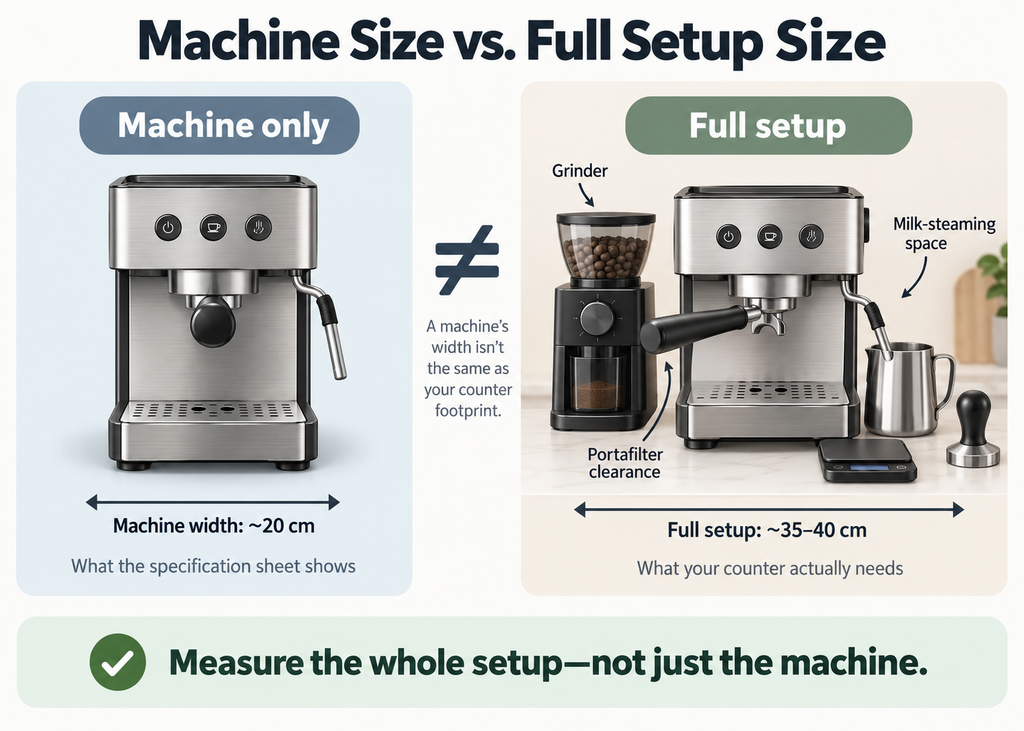
Looking only at machine width is the most common buying trap when shopping for a small espresso machine. Finding a compact espresso maker that works in a tight space means looking at the entire setup. A machine advertised at 19 cm wide can easily consume over 40 cm of real counter space once you set up the surrounding tools required to make coffee.
Leave Room to Use the Machine
The machine’s measurements aren’t the whole story. You also need enough space to operate it comfortably day to day:
- Side Space: Leave a few centimetres of open space on the sides so you can lock the portafilter handle into place and tilt your milk pitcher without bumping into walls or adjacent appliances.
- Space Above: Make sure you have enough overhead clearance under your upper kitchen cabinets to lift out rear water tanks or pour coffee beans into the hopper without sliding the machine forward every morning.
Separate Machine + Grinder vs. All-in-One Systems
Understanding the difference between separate setups and integrated systems helps prevent unexpected counter crowding:
- Separate Machine + Grinder Setups: Semi-automatic machines like the Breville Bambino Plus (19.6 cm wide) or De’Longhi Dedica Maestro Plus (20.8 cm wide) have small individual footprints. While pressurized baskets allow pre-ground coffee, pulling unpressurized single-wall shots for café-quality extraction requires a separate espresso-capable grinder. Choosing a compact espresso grinder (such as a Baratza Encore ESP or Fellow Opus) helps keep total counter width within 35–40 cm.
- All-in-One Systems: Systems with built-in grinders and automated dosing (such as the Meraki or Terra Kaffe Demi) measure wider on paper (19 to 37 cm wide). However, by combining grinding, dosing, and brewing into a single appliance, they eliminate secondary device clutter and keep your entire coffee setup within one defined footprint.
3. How to Measure Your Space Before Buying
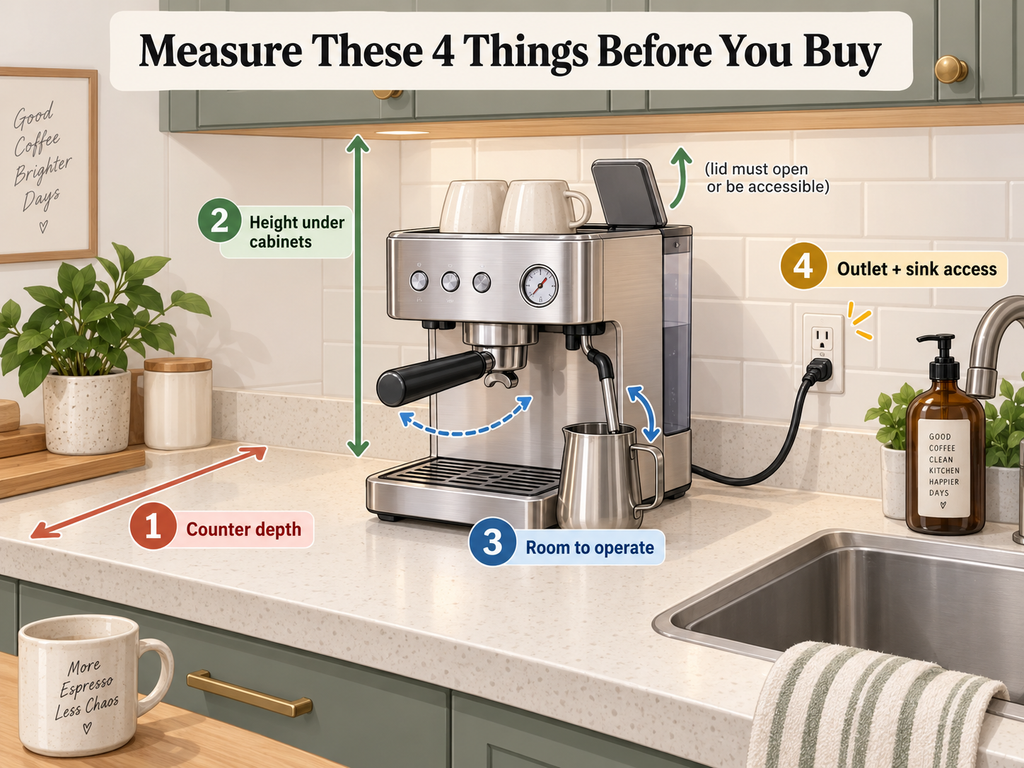
Before selecting a machine, perform a quick 4-point measurement of your coffee area:
- Usable Counter Depth: Measure from the backsplash to the front edge of the counter. Ensure your chosen machine leaves enough room in front for cup placement and drip tray removal.
- Cabinet Overhead Clearance: Measure from the countertop to the underside of your upper cabinets. Compare this against machine height plus the space needed to open water tank lids or bean hoppers.
- Side Wall Obstructions: Check for obstructions on both sides (refrigerators, side walls, paper towel holders) that could impede locking the portafilter or tilting a milk jug.
- Outlet & Sink Proximity: Confirm that a grounded outlet is within easy reach, and position your station close to the sink for convenient rinsing and filling.
4. Detailed Machine Recommendations by Apartment Profile
Finding the right small espresso maker comes down to matching your kitchen’s dimensions with your daily coffee habits:
Category 1: Speedster Semi-Automatics (Entry to Mid-Level)
- Breville Bambino & Bambino Plus
- Best for: Home baristas looking for one of the best small espresso machine options for a narrow counter and who don’t mind adding a separate grinder.
- Dimensions: 19.6 cm W × 32.0 cm D × 31.0 cm H (7.7″ W × 12.6″ D × 12.2″ H)
- Grinder Needed: Yes (External for single-wall extraction)
- Water Access & Milk System: Rear removable tank (1.4L on Bambino, 1.9L on Plus); manual steam wand on Bambino, hands-free automatic milk texturing on Plus.
- Small-Space Reality: As two of Breville’s smallest espresso machines, both Bambino models measure 19.6 cm wide (often misquoted as 16 cm in informal reviews). Both heat up instantly and take up minimal counter space, though you must budget extra width for a standalone grinder.
- De’Longhi Dedica Maestro Plus
- Best for: Beginners with ultra-narrow counter space who want simple controls and easy milk frothing.
- Dimensions: 20.8 cm W × 34.5 cm D × 32.8 cm H (8.2″ W × 13.6″ D × 12.9″ H)
- Grinder Needed: Yes (External for single-wall extraction)
- Water Access & Milk System: Rear removable tank (1.6L); automatic and manual milk frothing options.
- Small-Space Reality: An ultra-slim body designed to fit tight counter corners. It features simple controls and hands-free milk frothing, making it beginner-friendly, though it still requires a separate coffee grinder for freshly ground espresso.
Category 2: Integrated All-in-One Systems
- Meraki Espresso Machine
- Best for: Coffee drinkers who want a full dual-boiler setup with integrated grinding and weighing in a single defined footprint.
- Dimensions: 37.0 cm W × 37.0 cm D × 41.5 cm H (14.6″ W × 14.6″ D × 16.3″ H)
- Grinder Needed: No (Built-in)
- Water Access & Milk System: Rear top-loading water tank; integrated steam wand.
- Small-Space Reality: While 37 cm square is a substantial footprint, the Meraki integrates the machine, grinder, and weighing workflow into a single unit. If your counter cannot accommodate a separate machine and standalone grinder side-by-side, this integrated system keeps all prep within one clean zone.
- Terra Kaffe Demi
- Best for: Busy renters seeking a compact automatic espresso machine for hands-off bean-to-cup coffee and milk drinks with minimal manual prep.
- Dimensions: 19.0 cm W × 40.0 cm D × 32.5 cm H (7.5″ W × 15.7″ D × 12.8″ H)
- Grinder Needed: No (Built-in)
- Water Access & Milk System: Top-loading water tank (1.4L); fully automated internal brewing and self-cleaning.
- Small-Space Reality: Measuring only 19 cm wide, the Demi occupies no more space than a standard drip coffee maker while handling grinding, tamping, and brewing internally. It is ideal for users seeking minimal prep mess and minimal accessory storage.
Category 3: Prosumer Heavyweight (With Important Nuance)
- La Pavoni Cellini Mini X
- Best for: Prosumer coffee enthusiasts with deep, sturdy counters who want to brew espresso and steam milk simultaneously.
- Dimensions: 24.0 cm W × 43.0 cm D × 36.0 cm H (9.4″ W × 16.9″ D × 14.2″ H) | Weight: 20.4 kg (45 lbs)
- Grinder Needed: Yes (External)
- Water Access & Milk System: Rear removable tank (1.7L); 1.5L heat-exchanger boiler for brewing espresso and steaming milk simultaneously.
- Small-Space Reality: The Cellini Mini X shows why evaluating your full setup footprint matters. At 24 cm wide, it looks impressively narrow for a prosumer machine. However, its 43 cm depth requires deep countertops, its 20.4 kg weight requires sturdy cabinet support, and it requires space for a capable standalone espresso grinder. It is an excellent prosumer machine for making milk drinks quickly, but it needs a deep, sturdy counter rather than a micro-kitchenette.
5. Alternatives Box: Very Small-Space Options
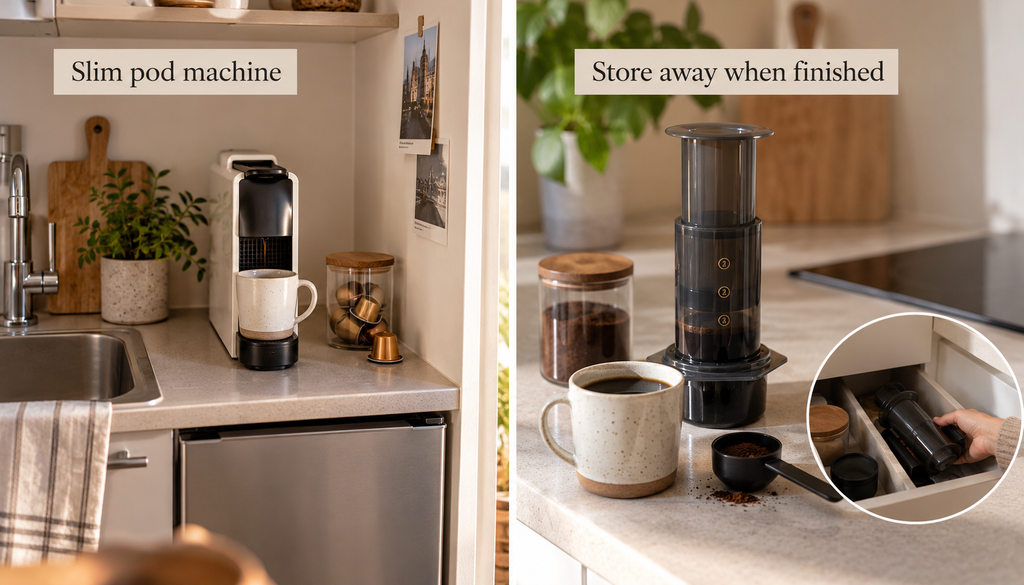
If counter space is entirely unavailable, non-traditional and pod-based options offer quality coffee without taking up permanent counter space:
Nespresso Essenza Mini & CitiZ
These slim pod machines take up very little counter space and do not require a separate grinder or most espresso-prep tools. They are a practical option for studio apartments, kitchenettes, or anyone who prioritizes convenience and minimal cleanup.
AeroPress Original
The AeroPress is a compact manual brewer that can be stored in a drawer or cabinet when not in use. It produces a strong, espresso-style concentrate without requiring permanent counter space, making it a useful option for very small kitchens or travel.
6. Real-World Apartment Workflow Tips
Operating espresso equipment in tight quarters introduces a few practical realities. These simple workflow adjustments keep your morning routine smooth and mess-free.
1. Stabilizing Lightweight Machines
Compact semi-automatic machines often feature lightweight outer housings. When locking a tight portafilter into the group head, light machines can slide across smooth countertops.
- Practical Fix: Place your off-hand firmly on the top or side frame of the machine to brace it while using your dominant hand to lock in the portafilter handle.
2. Drip Tray Management & Sink Proximity
Some compact machines send purge water into the drip tray during auto-flushes or steam wand cleaning cycles. Because compact drip trays hold limited volume, they fill up quickly.
- Practical Fix: Position your coffee setup within an easy step or pivot of your kitchen sink. This allows you to dump filled drip trays, rinse portafilters, and clean milk pitchers without dripping water across the kitchen floor.
7. Layout Strategies for Limited Counter Space
When counter space is tight, strategic placement prevents coffee gear from interfering with daily meal prep.
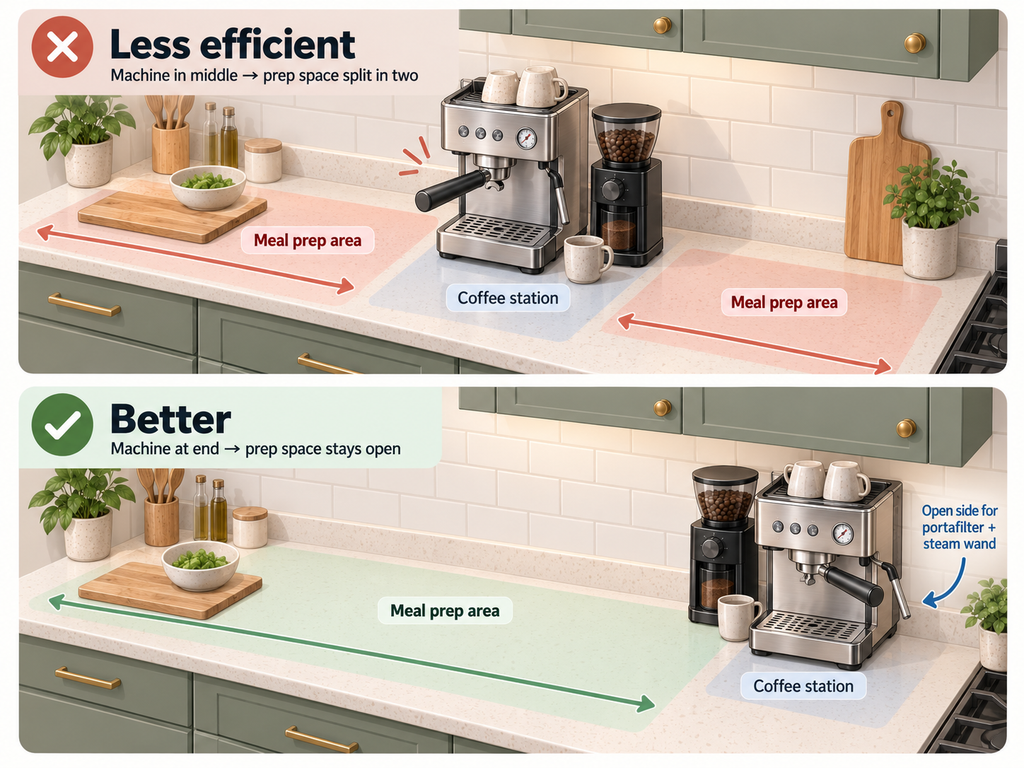
- The End-of-Counter Anchor: Place your espresso machine at the far end or corner of a counter run rather than in the middle. This gives the portafilter handle and steam wand open side access while leaving a larger uninterrupted area for cooking.
- Shallow Appliance Alcoves: If placing your setup under low cabinets or in an alcove, verify that you have enough overhead space to refill rear water tanks or top off bean hoppers comfortably.
- Dedicated Mobile Coffee Carts: When counter space is completely unavailable, a sturdy rolling cart with locking wheels creates an independent coffee bar. Use lower shelves for bean storage, water jugs, and towels. (If you’re evaluating options, see our guide to small-space coffee bar furniture for weight capacity, frame rigidity, and outlet safety checks.)
- Temporary Prep Surfaces: Use stove-top boards (over cold burners) or kitchen island corners for temporary espresso prep and tamping.
8. Storage and Decluttering
A cluttered coffee station makes a small kitchen feel even smaller. Streamlining your tool collection and using vertical wall space keeps your work surface clear.
| Storage Category | Standard Setup | Small-Space Apartment Solution | Practical Benefit |
|---|---|---|---|
| Coffee Prep Tools | Several separate preparation tools | Choose compact or combined tools and store rarely used accessories in a drawer | Reduces counter clutter |
| Cleaning Gear | Countertop brushes, cloths, and bottles | Storing brushes and cloths in a drawer or neatly hung on side rails | Keeps primary counter space completely clear |
| Bean Storage | Several open coffee bags on the counter | Narrow wall shelving (10 cm depth) on unused wall space | Converts dead wall space into functional storage for active coffee bags |
| Bean Preservation | Storing extra bags next to the machine | Vacuum-sealing and freezing extra portions; keeping only active coffee out | Protects bean freshness while clearing counter clutter |
9. Pre-Purchase Checklist
Before buying a compact espresso machine, complete this final 5-point home audit:
- Measure Usable Depth & Height: Verify available counter depth from backsplash to edge, plus vertical clearance under upper cabinets for tank or hopper access.
- Check Side Working Clearance: Confirm adequate side space for portafilter handle rotation and steam wand movement.
- Verify Outlet & Sink Access: Ensure the setup sits near a grounded power outlet and within easy reach of the sink for rinsing and filling.
- Account for Grinder Space: If selecting a modular semi-automatic machine, budget counter width and funds for a dedicated espresso burr grinder.
- Plan Water Quality: Budget for filtered or re-mineralized water to protect internal boilers and heating blocks from scale buildup.
Summary: Setting up a coffee corner in a small kitchen isn’t about finding the absolute smallest machine on the market—it’s about building a setup that gives you great espresso without taking over your kitchen.