Budget Home Espresso Setups: Three Small-Kitchen Builds and How to Price Them
A compact espresso machine may fit beside the toaster, but that does not mean the whole setup will. You still need a way to prepare the coffee, somewhere to set down the cup, and enough room to use and clean the equipment. And the price on the machine rarely equals the amount you need to spend.
Here are three ways to build a small-kitchen espresso station: a manual lever setup you can put away, an electric setup for a regular milk-drink routine, and a lower-cost electric machine paired with a hand grinder. None is a universal winner. This guide shows what each path needs, which prices are documented, and which costs you still have to quote. Choose the complete routine first; calculate the purchases second.
Three espresso setups, compared
-
1. Manual lever — Flair NEO Flex (the $89 price example is refurbished) + KINGrinder K6
What to buy—and what is priced
Check the exact NEO Flex generation and included brew parts; add a K6, suitable water heating and a scale if wanted. Price status: Flair’s U.S. maker listing showed $89 for a refurbished NEO Flex; K6, scale and any new water-heating item still need retailer quotes.
The everyday tradeoff
Can be stored between uses; requires hands-on grinding, separate water heating and room to move the lever. No built-in milk steamer.
-
2. Daily electric — Breville Bambino BES450 + Baratza Encore ESP
What to buy—and what is priced
Check the regional Bambino kit and grinder; confirm the included filters, tamper and milk jug before buying extras. Price status: U.S. maker listings Bambino $299.95 + Encore ESP $199.95 = $499.90 for machine + grinder only; any other purchases, tax and delivery are additional.
The everyday tradeoff
Electric grinding and a machine steam wand suit a station left ready to use, but two appliances occupy counter space and need suitable power.
-
3. Lower-cost electric — De’Longhi Stilosa EC260BK + KINGrinder K6
What to buy—and what is priced
Start with the factory-supplied portafilter and filters; add a K6 and any genuinely needed tools. Price status: De’Longhi’s U.S. listing showed $149.95 for the Stilosa machine only; grinder and other new purchases still need quotes.
The everyday tradeoff
Lower listed machine price than the Bambino; hand-grinding remains part of the routine.
Price reference: U.S. manufacturer pages checked on November 6, 2026, in USD. These are individual product listings, not verified complete-cart prices or stock guarantees. Product availability and supplied accessories can vary by model version and country.
Build 1: A manual espresso station you can put away
Flair’s NEO Flex refurbished listing describes a lever espresso maker with a thin-walled brew cylinder, a pressure gauge and two portafilter options: Flow-Control and Bottomless 2-in-1. Those details refer to the listed refurbished configuration, not every new or older NEO Flex kit. Check the seller’s exact generation, configuration and included parts before buying.
Pairing it with the KINGrinder K6 gives you an adjustable manual burr grinder; KINGrinder’s K4/K6 comparison explicitly identifies the K6 as capable of grinding for espresso. But the grinder is a separate purchase, and you must have a suitable way to heat water. A kitchen kettle you already own may remove that new purchase from the bill; it does not remove the water-heating step from your morning.
Choose this route if you like a hands-on process and want the option to clear the counter afterward. Before buying, picture the full sequence: grind, heat water, assemble, raise and lower the lever, then empty and clean the parts. Make sure the lever can move freely where you intend to brew, not just where the frame can be stored. Because the NEO Flex has no built-in steam wand, milk drinks would call for an additional method and possibly more equipment.
Build 2: An electric setup for frequent espresso and milk drinks
The Breville Bambino BES450 has a manual milk-steaming wand and a ThermoJet system that Breville describes as heating in about three seconds. That is a heater claim, not a measured time to make and clean up an entire drink. The Baratza Encore ESP ZCG495 provides an electric grinder with an espresso-focused adjustment range and an included dosing cup.
Together they suit someone who expects to leave a coffee station ready for regular use. That convenience comes at the cost of space for both machines, a suitable power arrangement following their manuals, and room to remove the water tank, fill the grinder and turn the portafilter. A small kitchen might accommodate the equipment but still lack a comfortable place to prepare a cup or move a milk pitcher.
Check the Bambino’s exact regional box contents. The U.S. product page lists single-wall and dual-wall filter baskets; the Canadian product page lists dual-wall baskets, while a Breville instruction manual depicts both types. Those sources do not prove the contents of every current retail box. Confirm your SKU and supplied filters before ordering extras.
Choose this route if electric grinding and a built-in steam wand matter more to you than reclaiming every inch of counter between drinks. Do not assume that a machine advertised as compact makes the two-appliance station compact enough for your kitchen.
Build 3: A lower-priced electric machine, without a required modification project
The De’Longhi Stilosa EC260BK is an electric pump machine with a manual milk frother. De’Longhi lists a portafilter, filters for single and double espresso, and a measuring-spoon/tamper among the supplied items. Start by planning around those factory-supplied parts, rather than putting an aftermarket filter basket on your essential-purchases list.
The K6 hand grinder keeps the setup modular, but it also means grinding by hand before using an electric machine. Compared with the Bambino-and-Encore pairing, the machine is less expensive on the cited U.S. manufacturer listings, while the daily workflow asks more manual effort. A separate milk pitcher may be useful if you make milk drinks; check the kit before spending money on one.
Choose this route if you want an electric espresso maker but are comfortable trading electric grinding for hand-grinding time. Follow the instructions for your precise Stilosa model when using or cleaning the steam wand; this is not a project that requires unverified modifications to begin brewing.
What do the three setups cost?
A machine price is evidence for one line of a shopping cart—not for the whole cart. For a comparable reference, the U.S. manufacturer pages checked on November 6, 2026 displayed these prices in USD:
- Manual lever: Flair displayed $89 for a refurbished NEO Flex in a specified configuration—not a verified new unit at $119. The K6, optional scale and any needed water-heating purchase were not supported by dated U.S. seller quotes in this research. Flair’s refurbished listing.
- Daily electric: Breville listed the Bambino at $299.95 and Baratza listed the Encore ESP at $199.95. Their machine-and-grinder subtotal is $499.90. It excludes a scale or other purchases you need, plus applicable tax and delivery. Breville · Baratza.
- Lower-cost electric: De’Longhi listed the Stilosa EC260BK machine at $149.95. The hand grinder and any separately needed accessories still require current seller quotes. De’Longhi.
Those figures are dated displayed manufacturer prices, not proof of current inventory or completed checkout totals. The Bambino-and-Encore pair nearly uses a $500 equipment budget before any other purchase. None of the three builds can honestly be advertised as a verified, universally available “complete setup under $500” on these sources alone. If you live outside the U.S., obtain local prices in your own currency rather than converting these figures into an unverified shopping claim.
Your complete espresso setup cost worksheet
Copy this two-column, print-or-copy worksheet into a note, or print it. For each purchase, use a quote for the exact model, market and seller. Mark required now, recommended, optional later or already owned; something suitable that you already own adds $0 in new spending. Do not count optional upgrades in your starting budget.
- Chosen build; country and currency
- Target budget / spending ceiling
- Machine: model/SKU; required now or owned?
- Machine quantity × quoted unit price; seller and date (new spending only)
- Grinder: model/SKU; required now or owned?
- Grinder quantity × quoted unit price; seller and date (new spending only)
- Scale: recommended / optional / owned?
- Scale quantity × quoted unit price if buying; seller and date
- Water heating for the Flair: required method; owned or buy?
- Any heating item quantity × quoted unit price; seller and date
- Other items needed now: item and whether required / owned; confirm box contents first
- Other required item(s) quantity × quoted unit price; seller and date
- Required new-purchase subtotal (exclude owned and optional-later items)
- Tax, delivery and other checkout fees (use actual seller quote)
- Estimated total to spend now (subtotal + fees)
- Budget headroom (ceiling − total): positive = within budget; negative = over
- Optional upgrades for later (list but exclude their cost above)
- Machine and grinder housing sizes (W × D × H for each; verify orientation)
- Counter fit and movement test: lever/portafilter, water/hopper access, grinding and cup/milk space
- Setup and cleanup tradeoff: leave ready or stow; time and effort you will accept
- Decision: both within budget and workable in your actual space/routine?
Calculation: For each required item not already owned, multiply quantity by the seller’s current unit price; sum those rows, then add the actual tax, delivery and other fees. Budget headroom = your spending ceiling − estimated total: a negative figure means the plan exceeds your ceiling. Keep recommended or optional purchases separate unless you decide they are required for your chosen drinks. Prices and box contents can change; coffee beans and ongoing supplies are separate recurring costs.
A scale is useful for measuring coffee dose and finished espresso, but it is not a universal factory requirement to make a shot. Likewise, an extra basket is not an automatic beginner purchase: verify the equipment included with your precise machine first.
Check the working space—not just the machine dimensions
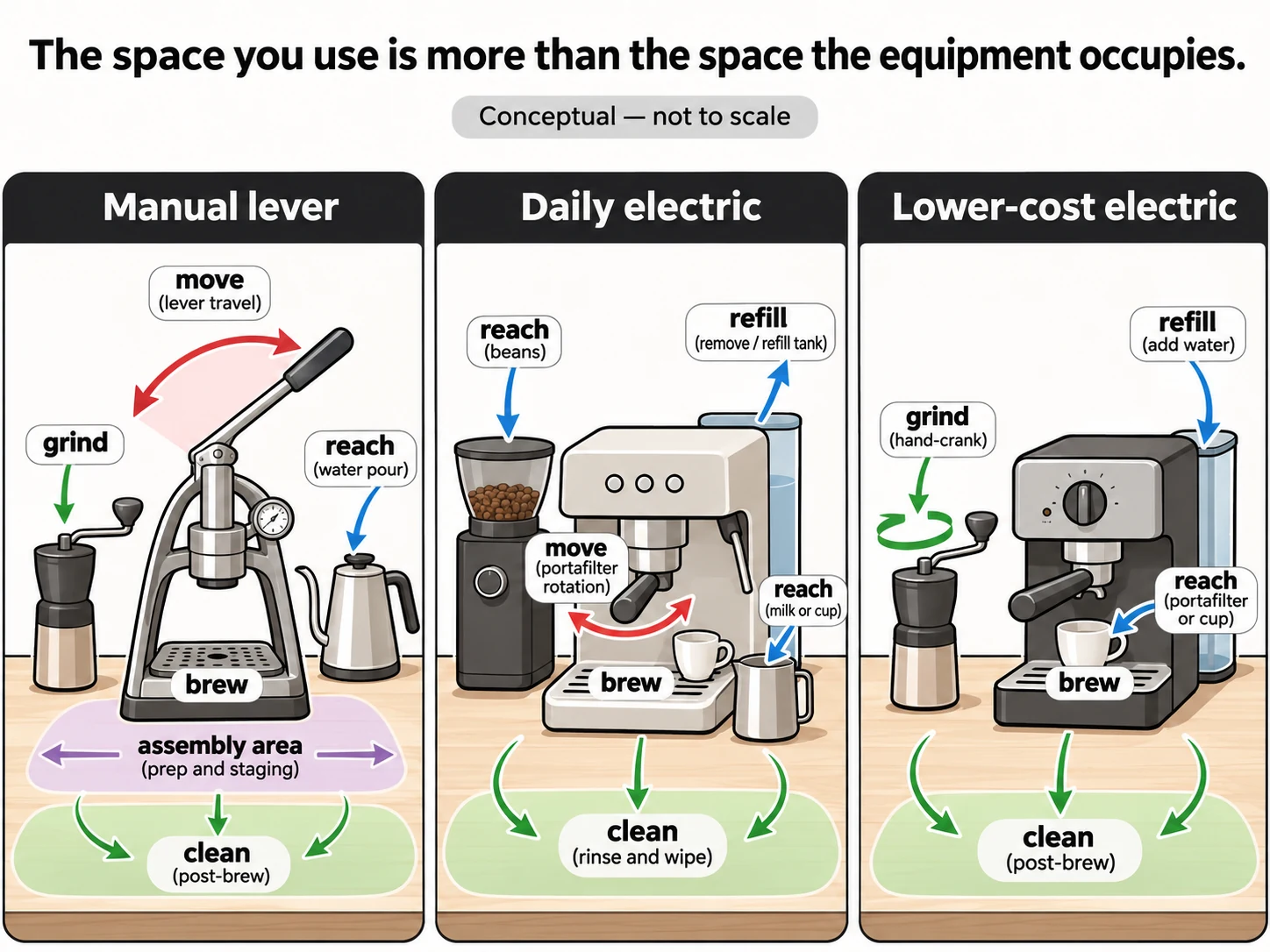
Before ordering, put two placeholders on the counter where the espresso machine and grinder would sit. Then walk through the tasks you expect to perform:
- Reach: Can you fill the water tank or kettle, reach the grinder hopper and get a cup into position without clearing the kitchen first?
- Move: Can you turn the portafilter, use the hand grinder or raise the Flair lever without striking a wall or cabinet?
- Prepare: Is there somewhere to put a scale, beans, tamper and—if relevant—a milk pitcher while making the drink?
- Finish: Can you empty the coffee, wipe up and return the counter to normal use? If you plan to stow equipment, where will it go?
The relevant clearance depends on the model, the actual cabinet layout and the movements you use. Do not substitute a universal minimum width or an unverified reinterpretation of a manufacturer’s dimension labels for this check. Consult the model-specific manual for power and safe operation.
Which one earns its place?
If you enjoy preparing espresso by hand and want the counter back afterward, the Flair route is worth comparing—but make sure you are happy with the separate water-heating step. If milk drinks and a station that stays ready matter most, the Bambino plus Encore ESP is the more convenient starting point to evaluate, provided the whole station fits and the complete cart fits your budget. If you want an electric machine at a lower initial machine price and do not mind hand grinding, the Stilosa route keeps the setup simple without mandatory upgrades.
The next useful step is not adding another accessory to your cart. Fill in the worksheet with the exact products and seller quotes you can actually obtain, then test the work area with the full morning routine in mind. That is how you decide whether the setup earns its place.