Choosing a Grinder for a Compact Home Café
Last updated: October 2026
Most coffee gear reviews evaluate grinders from an idealized perspective: sprawling kitchen islands, commercial footprints, and endless power outlets. But for home baristas crafting coffee in apartment kitchens, studio nooks, or tiny counter spaces, those reviews miss the mark.
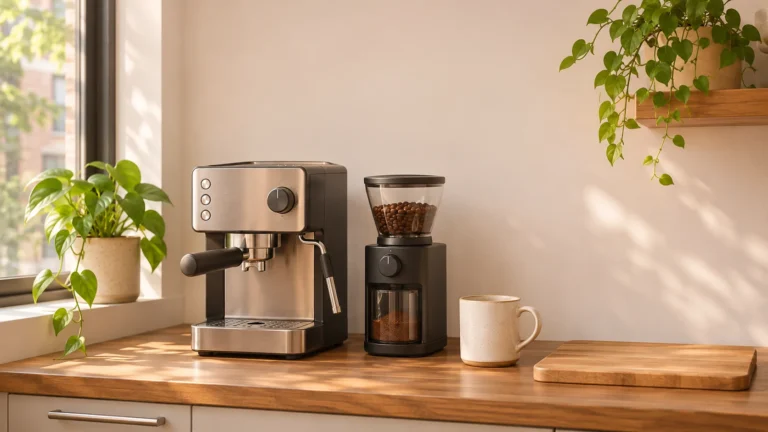
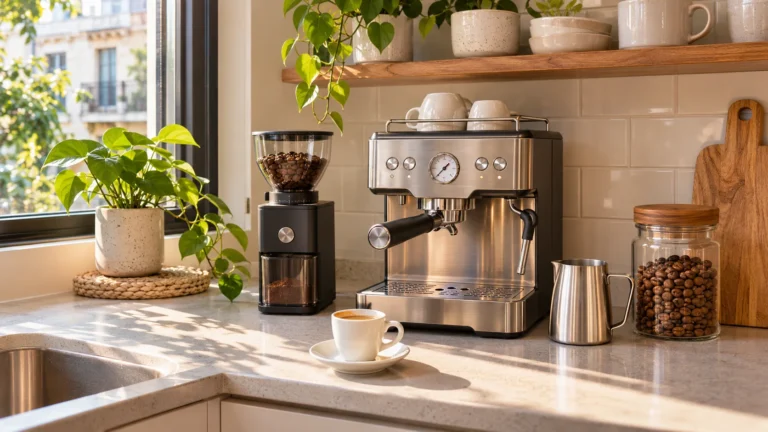
When counter space is measured in inches, a grinder needs to suit both your brewing method and the way you use the kitchen. Check its operating and refill access, grounds handling and power connection—not only its closed dimensions. If household noise matters, compare evidence for the exact model or try it in your own setting rather than assuming a compact grinder will be quiet.
Upgrading from pre-ground coffee or a blade grinder to a quality burr coffee grinder is one of the most effective ways to improve grind consistency and extraction. Blade grinders create a wider mix of fine and coarse particles, which can contribute to uneven extraction, while burr grinders provide much more controlled grinding. For a compact home café, however, the best coffee grinder also needs to match your brewing method and fit your available counter and storage space.
The 4 Invisible Constraints of a Small Kitchen
When designing a compact home café, four physical realities dictate which grinder will actually work in your space:
- Vertical Clearance & Cabinet Height: Bulky commercial hoppers often collide with standard upper kitchen cabinets. Low-profile grinders fit beneath overhead cupboards, while compact hand grinders can often be stored in a drawer.
- Static & Mess Management: In tight quarters, escaped grounds can reach nearby counters and appliances. Anti-static systems, retention and catch-cup design vary by model; compact size does not guarantee any of these features. For example, Fellow describes an integrated ionizer in the Opus 2. Check the exact grinder’s features and cleaning instructions.
- Acoustic Environment (Noise Level): High-pitched motor screech reverberates through thin apartment walls. Grinder noise depends on motor speed, burr design, enclosure construction, and vibration control, making independent noise measurements more reliable than motor RPM alone. For household timing and brewing alternatives, see our quiet coffee setup guide.
- Cord Clutter & Counter Real Estate: Small kitchen counters rarely have spare electrical outlets. Rechargeable cordless electrics and manual hand grinders remove trailing cords entirely, allowing for flexible placement anywhere.

Start Here: What Do You Actually Brew?
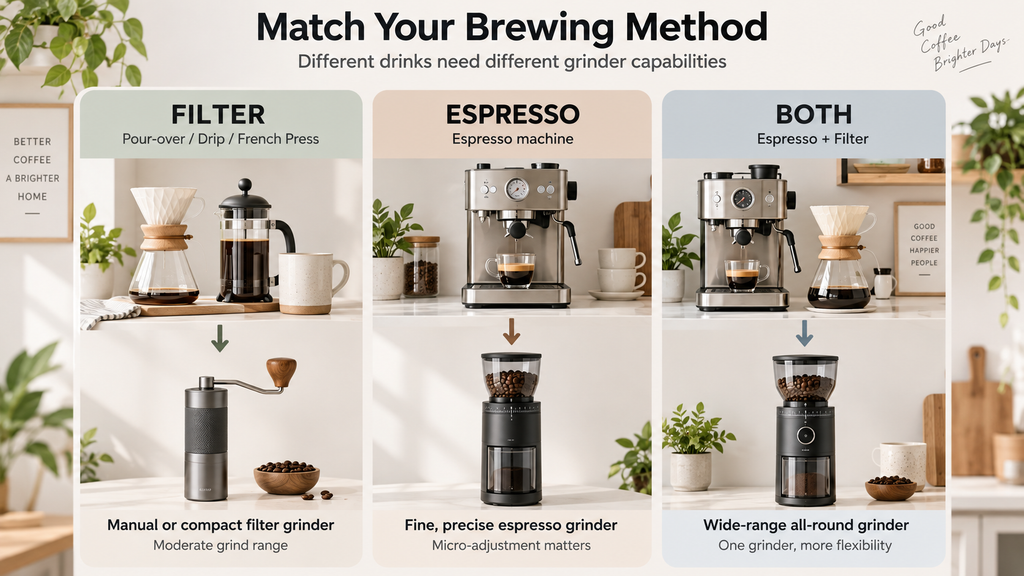
Before measuring counter depth or comparing motor noise, the first decision must be your intended brewing method. An ultra-compact grinder that cannot adjust finely enough for espresso is useless next to an espresso machine, while a dedicated filter grinder may not grind finely enough—or offer sufficiently precise adjustment—to dial in espresso properly.
Use this decision matrix as your primary selection filter:
| Your Primary Setup | Grind Precision Needed | Small-Space Recommendation |
|---|---|---|
| Pour-over / Drip / French Press | Moderate adjustment range | Steel burr manual or compact filter electric |
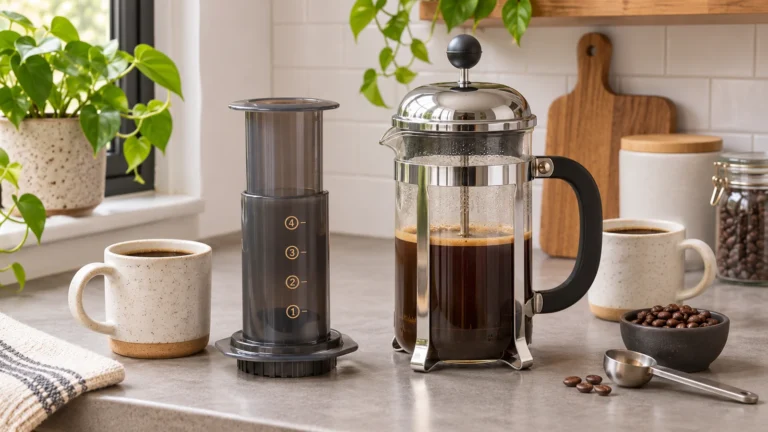
| Moka Pot / AeroPress | Fine-to-medium capability | Quality manual or versatile compact electric |
| Espresso | Micro-adjustment precision | Compact espresso-capable single-doser |
| Espresso + Filter (All-Rounder) | Wide, flexible grind range | All-purpose single-dose electric or high-end manual |
| Multiple drinks/day or multi-person | Speed & throughput matter | Compact electric grinder; choose single-dose if switching beans or having limited cabinet clearance |
| 1–2 drinks/day (Solo brewing) | Manual grinding is practical | Manual steel burr hand grinder |
Why Single-Dose Coffee Grinders Work Well in Small Spaces
Once you know your brewing method, workflow becomes the second major filter. For small kitchens, switching to a single dose coffee grinder avoids large storage hoppers and can reduce the amount of coffee retained between doses. In standard hopper-style grinders, whole beans are stored in a large top vessel. While convenient in high-volume commercial settings, hoppers present practical drawbacks in a tight kitchen:
- Stale Grounds in the Chute: On-demand hopper grinders can retain leftover grounds in internal chutes. In a home setting where you only brew 1–2 cups a day, those retained grounds can oxidize and mix with the next dose.
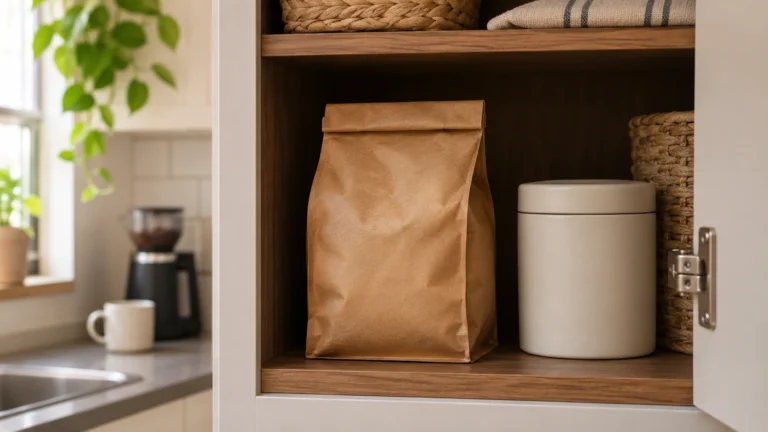
- Relocated Storage Footprint: Storing whole beans in airtight canisters in a pantry relocates bean storage away from prime counter space, reducing the vertical clearance needed above the grinder.
- Flexibility Across Beans: Single-dosing allows you to weigh only the exact grams you need per cup. You can seamlessly rotate between light roasts, decaf, or dark roasts without having to empty or swap a hopper—ideal if you switch between espresso and filter brewing.
Grinder Categories & Models Tailored to Small Spaces

Category A: Manual Coffee Grinders (Hand Grinders)
A hand coffee grinder often offers strong grind quality for the price while eliminating the motor, electronics, power cord, and associated noise of an electric grinder. They operate with minimal noise, require no wall power, and easily tuck into a drawer when not in use.
- Trade-Off to Consider: Effort and throughput. Grinding 15 grams for a morning pour-over is quick and satisfying. However, grinding 36 grams of light-roast coffee fine enough for back-to-back espresso shots requires noticeable physical effort and time.
Key Models:
- KINGrinder P1: An entry-level manual grinder featuring a lightweight body, 38mm stainless-steel burrs, and a relatively coarse stepped adjustment system. Its compact size makes it well suited to filter and Moka pot brewing.
- Timemore Chestnut C3s Pro / C3s Max: Built with an aluminum alloy body and S2C 660 hardened steel burrs. Note that the C3s Pro uses stepped click adjustments (not stepless). While the C3s Pro can grind fine enough for espresso, its relatively large adjustment steps make precise espresso dialing less convenient than on an espresso-focused grinder. The C3s Max increases grounds capacity by 50%.
- 1Zpresso K-Ultra: A premium all-rounder featuring an external adjustment dial and a quick-release magnetic catch cup. It offers fine external adjustment suitable for both espresso dial-in and pour-overs.
- 1Zpresso Q Air: A budget-friendly, lightweight manual grinder under US$70 designed specifically for pour-over brewing in a slim, travel-friendly frame.
Category B: Compact Electric Coffee Grinders (Low Profile & Precision)
For home baristas who want electric speed without giving up much counter space, a small electric coffee grinder can be a practical middle ground. If espresso is part of your routine, prioritize a burr grinder for espresso with sufficiently fine, precise adjustment; filter-focused models can prioritize simpler controls and a compact footprint. Use this comparison as a specification-based shortlist, not a measured noise ranking or proof that a grinder will fit beneath your cabinets. Confirm dimensions, refill access and care instructions for the exact version before ordering.
- Fellow Opus 2: Updated with 48mm conical burrs, a stepless adjustment ring, low-retention drop path, and an automatic shut-off feature that stops the motor once beans clear the chamber. A versatile option for filter and espresso.
- DF54: A compact single-dose grinder featuring 54mm custom flat burrs, a sturdy aluminum body, stepless adjustment, an anti-static chute, low retention, and support for both espresso and filter brewing at a sub-US$300 price point.
- Oxo Compact Conical Burr Grinder: A budget-friendly electric grinder with a 3.75-inch square footprint, 15 main settings with 29 micro-adjustments, and a 50g capacity. Its stepped adjustment system makes it better suited to brewed coffee than precise espresso dialing.
- Fellow Ode Gen 2: Filter Coffee Specialist (Not for Espresso). Designed specifically for pour-over, drip, and French press, this grinder pairs 64mm flat burrs with a sleek, low-profile aesthetic, quiet operation, and an anti-static ionizer to reduce flyaway mess. Skip this model if espresso is part of your daily routine.
Category C: Portable & Cordless Electric Coffee Grinders
A portable electric coffee grinder powered by a rechargeable battery can be a practical option when counter outlets or cord clutter are genuine physical constraints in your kitchen.
- TIMEMORE MILLAB E01: A Red Dot Design Award winner featuring 60 adjustment steps in 0.025mm increments. Operating on a rechargeable battery, it handles pour-over through espresso without requiring a wall outlet.
- Femobook Series (A4Z / A2): Rechargeable single-dosers designed for cord-free operation. The Femobook A4Z runs at approximately 54 RPM with a specialized conical burr set tailored for light-roast filter coffee, while the ultra-compact Femobook A2 features a 38mm conical burr, 120+ stepped adjustments, and a replaceable rechargeable battery in a travel-friendly body.
Dimensions & Specifications Comparison

For a small-space home café, physical dimensions and real in-use footprints are just as critical as burr specs. Compare footprints and capabilities below:
| Grinder Model | Footprint (W × D) | Height | Type | Espresso Capable? | Single Dose? | Small-Space Advantage |
|---|---|---|---|---|---|---|
| Oxo Compact Conical | 3.75″ × 3.75″ | 10.75″ | Electric | Limited / Filter Focus | Yes (50g) | Ultra-tiny 3.75″ square footprint |
| Fellow Ode Gen 2 | 4.1″ × 9.4″ | 9.8″ | Electric | No (Filter only) | Yes | Low profile, anti-static ionizer |
| Fellow Opus 2 | 5.1″ × 8.1″ | 10.5″ | Electric | Yes | Yes | Auto shut-off, versatile range |
| DF54 | 4.5″ × 7.0″ | 12.0″ | Electric | Yes | Yes | 54mm flat burrs in compact metal body |
| TIMEMORE MILLAB E01 | Stand: 3.2″ × 4.0″ (Body: ~2.8″ dia) | 7.8″ | Cordless Electric | Yes | Yes | Battery-powered, dockable or drawer-stored |
| Femobook A2 | 2.4″ × 2.4″ | 8.3″ | Cordless Electric | Moka/filter focus | Yes | Low RPM operation, replaceable battery |
| 1Zpresso K-Ultra | 2.0″ × 2.0″ (body) | 7.3″ | Manual | Yes | Yes | External adjustment, drawer-friendly |
| Timemore C3s Pro | 2.0″ × 2.0″ (body) | 5.8″ | Manual | Limited dial-in | Yes | Durable all-metal build, stores anywhere |
| KINGrinder P1 | 2.0″ × 2.0″ (body) | 6.0″ | Manual | Filter/Moka focus | Yes | Drawer-storable; no permanent counter space required |
Note: Prices and availability checked October 2026 in USD.
Practical Workflow Hacks for Small Counters
Keeping a compact setup clean and functional relies on two simple habits:
- Water-on-Beans Techniques: Do not add water to beans or grinder parts unless the exact grinder’s manufacturer explicitly permits the method and amount. If that guidance is absent, use the grinder dry and manage escaped grounds through its recommended dosing, catch-cup and cleaning routine.
- Dry Maintenance: Moisture can promote corrosion on uncoated steel burrs and internal components. Unless the manufacturer specifies otherwise, clean burrs and internal components dry using a stiff brush. When using cleaning pellets (like Urnex Grindz), check product instructions first.

Summary Decision Guide — Which One Fits Your Setup?
To choose the right grinder for your compact home café, match your setup to these five profiles:
- Tiny Space + Filter / Pour-Over Focus: Choose a steel-burr hand grinder like the Timemore C3s Pro or 1Zpresso Q Air. If you prefer an electric setup, the Fellow Ode Gen 2 is a low-profile flat burr grinder designed for filter brewing.
- Tiny Space + Dedicated Espresso: Opt for a compact espresso-capable single-doser like the DF54 or Fellow Opus 2.
- Tiny Space + All-Rounder (Espresso & Filter): The DF54 offers 54mm flat burr versatility under US$300. For manual all-round brewing, the 1Zpresso K-Ultra provides fine external adjustment control.
- Multiple Drinks Every Morning: A compact electric grinder can reduce repeated hand-grinding effort. For espresso, shortlist models with suitable fine adjustment, such as the Fellow Opus 2 or DF54; treat the OXO Compact here as a brewed-coffee option, not a precise espresso-dialing recommendation. Check dose capacity and the effort needed to switch between your actual drinks.
- No Convenient Outlet / Minimal Cord Clutter: Select a rechargeable cordless electric like the MILLAB E01 or Femobook A4Z, or go completely manual.