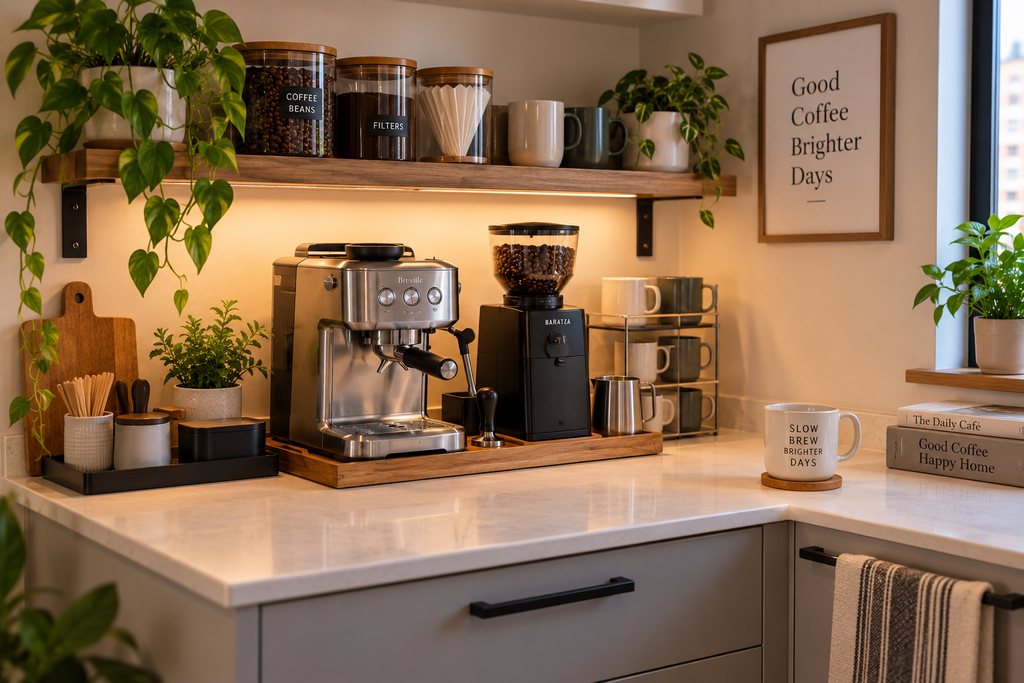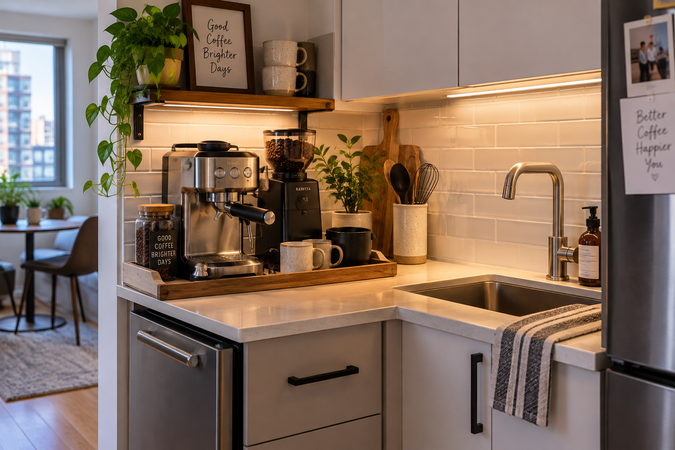
Creating a cozy coffee shop experience at home sounds luxurious—until an espresso machine, grinder, mugs, bean bags, and accessories consume half your kitchen counter. Waking up in a compact studio or urban apartment often means navigating a narrow galley kitchen just to reach a single outlet by the sink.
If you’re looking for coffee bar ideas for small spaces, a functional, attractive coffee corner doesn’t require custom cabinetry or sprawling countertops. When setting up a coffee station in a tight footprint, it all comes down to thoughtful space planning, vertical storage, and renter-friendly solutions.
To design a streamlined home cafe in a small space, follow this 5-Step Design Methodology:
- Measure Your Available Coffee Zone: Map out your exact footprint, including cabinet clearances, steam paths, and outlet reach.
- Choose Your Station Layout: Select a layout model tailored to your room’s physical constraints (countertop, cart, pantry, or desk).
- Right-Size Your Equipment: Choose compact, multi-functional brewing gear that fits your physical space.
- Build Storage Upward & Inward: Maximize vertical wall space and cabinet interiors with renter-safe, non-damaging organizers.
- Optimize Workflow & Finish the Look: Arrange your tools in brewing order and add warm lighting and personal touches.
Step 1: Measure Your Available Coffee Zone
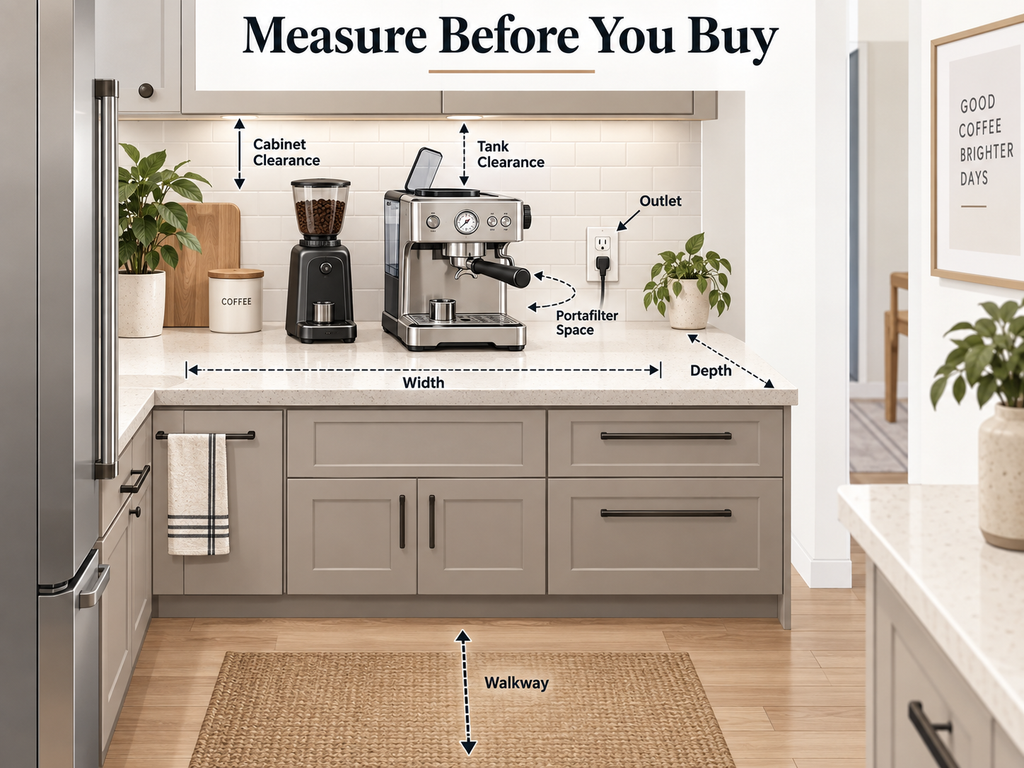
Before buying a single mug or appliance, measure the exact dimensions of your proposed coffee spot. The biggest mistake when planning a coffee corner isn’t picking a machine that’s too wide—it’s forgetting how much operational space the brewing process actually requires.
The Small-Space Coffee Zone Dimension Worksheet
| Measurement Point | Why It Matters | How to Measure Accurately |
|---|---|---|
| Available Surface Width | Dictates appliance arrangement | Measure flat counter or shelf width, leaving room for a knock box or tamper mat. |
| Counter Depth | Determines if equipment fits | Compare usable surface depth with the manufacturer’s published machine depth, including rear reservoir and cord clearance. |
| Cabinet-to-Counter Clearance | Affects machine refilling & steam | Measure from counter to upper cabinet bottom. Compare against machine height with water tank lid open. |
| Water Tank & Hopper Access | Prevents daily machine sliding | Check if your water reservoir lifts straight up out of the back or slides out sideways. |
| Portafilter & Drawer Swing | Ensures operational clearance | Measure enough open space to insert and rotate the portafilter and fully remove the drip tray or grounds drawer. |
| Outlet Proximity | Reduces reliance on extension cords | Ensure factory power cords reach a grounded outlet safely without crossing wet sink prep areas. |
| Walkway & Aisle Width | Preserves kitchen traffic flow | Preserve the room’s existing safe circulation space; standard kitchen guidelines (NKBA) recommend 36″ for walkways, so ensure your coffee station does not narrow walkways. |
Step 2: Choose Your Station Layout Model
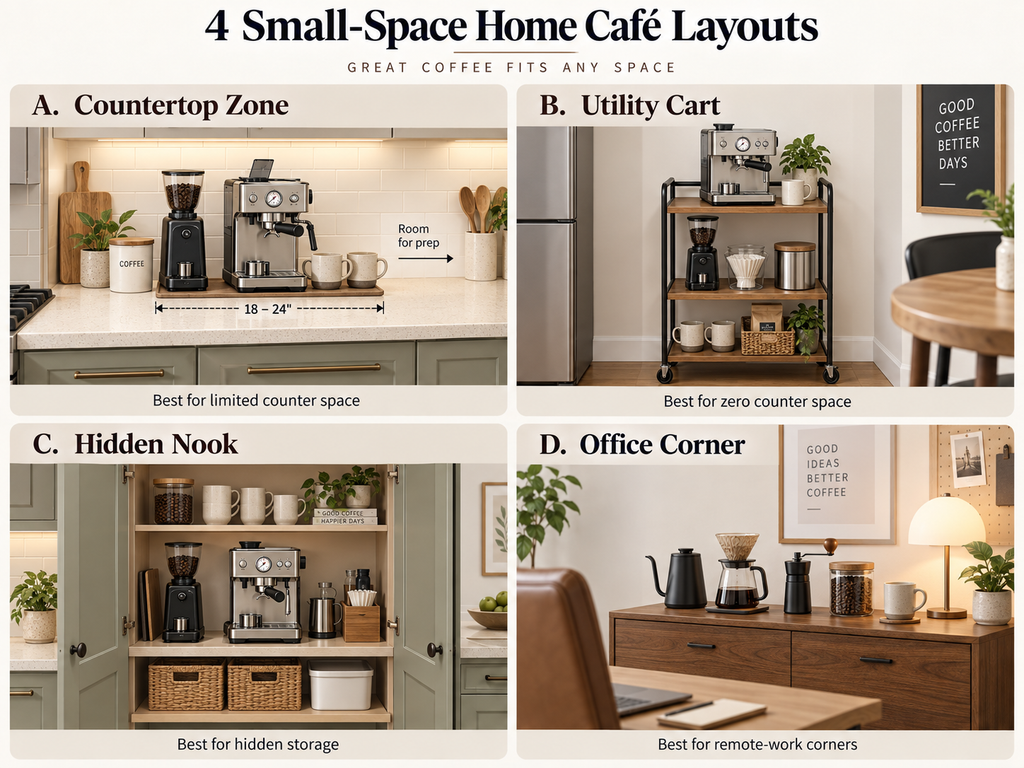
Depending on your apartment’s layout, choose one of these four proven station setups:
Layout A: The 18-to-24-Inch Countertop Zone
- Best For: Galley kitchens with limited flat counter space.
- How It Works: Restrict your everyday equipment to a single tray or wooden riser approximately 18 to 24 inches wide. One of the simplest kitchen coffee station ideas is to contain your espresso machine, bean canister, and grinder on a dedicated tray, preventing “appliance creep” from consuming the rest of your meal-prep counter.
- Key Feature: A 12″ x 18″ wooden tray with a small drawer underneath for filters and tampers.
Layout B: The Narrow Utility Cart Station
- Best For: Apartments with zero available counter space.
- How It Works: A multi-tier metal utility cart creates an instant, self-contained coffee station. Place the brewer on the top shelf, store beans and grinders on the middle shelf, and keep extra mugs, filters, or unopened shelf-stable supplies in bins on the bottom tier.
- Safety & Load Check: Choose a narrow utility cart with a rigid, level top and a load rating comfortably above the combined weight of your brewer and accessories. Locking casters are preferable for machines that require force when inserting a portafilter.
Layout C: The Hidden Pantry or Appliance Nook
- Best For: Studio apartments where visual minimalism is the top priority.
- How It Works: Dedicate a lower cabinet shelf, pantry rack, or hutch interior to your coffee tools. Keep equipment, beans, and grinders tucked behind closed doors to eliminate visual clutter.
- Operational Safety Note: Cabinets and pantry shelves are for out-of-sight storage. When operating heat- or steam-generating appliances (like espresso machines or kettles), ensure the space is fully open or pull the machine forward onto an open prep surface to prevent excess heat and moisture buildup and to maintain the manufacturer’s required clearances.
Layout D: The Home-Office Coffee Corner
- Best For: Remote workers wanting a quiet, dedicated morning or afternoon brewing ritual.
- How It Works: Use a shallow console table, sturdy sideboard, or appropriately anchored modular cabinet in a corner of your home office.
- Key Consideration: Prioritize a manual grinder or a quieter electric grinder, and store beans in airtight canisters to prevent coffee prep noise from disrupting video calls.
💡 Need help choosing the right piece of furniture? If you’re deciding between a rolling island, a concealed appliance garage, a corner unit, or a vertical baker’s rack, read our complete guide to Coffee Bar Furniture for Small Spaces: Cabinets, Carts & Hutches for exact measurements, frame stability checks, and power safety guidelines.
Step 3: Right-Size Equipment for Small Spaces
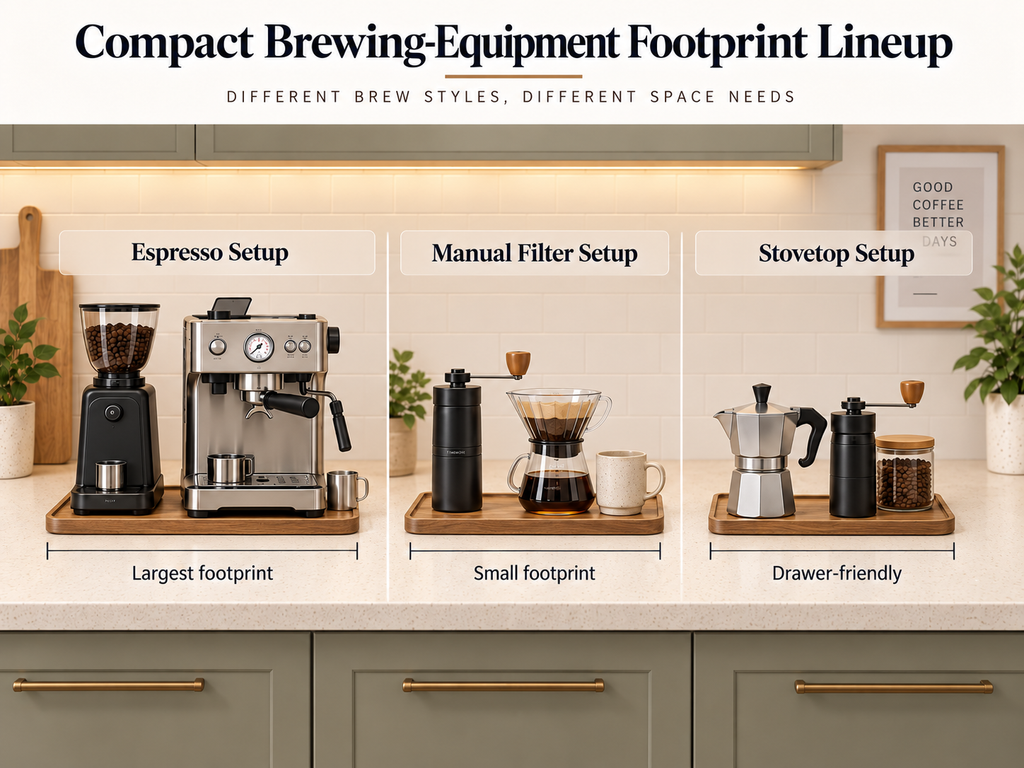
In a small-space home café, equipment footprint matters just as much as brew quality. When comparing coffee machines for home use, look beyond brewing performance and check the machine’s actual width, depth, height, and refill clearance.
Ultra-Compact Espresso Machines
- Slim Footprint Units: Look for compact espresso machines under 12 inches wide with built-in steam wands. The Breville Bambino Plus is one example that combines espresso brewing and milk texturing in a relatively narrow footprint without taking over the counter.
- All-in-One Systems: Multi-functional machines can combine grinding, brewing, and sometimes automated milk texturing in one appliance, reducing the number of separate devices on the counter.
Space-Saving Burr Grinders
Grind consistency strongly influences extraction consistency and cup quality.
- For Filter Coffee: Compact grinders (such as the Timemore C2 or C3) provide excellent grind uniformity for pour-over, AeroPress, or French press while taking up minimal storage space.
- For Espresso: Choose a grinder specifically designed with fine adjustment steps for dialing in espresso (such as espresso-focused models from 1Zpresso or Kingrinder).
- Compact Electric Grinders: If choosing an electric grinder, opt for compact multi-purpose models (such as the Baratza Encore ESP, Fellow Opus, or Turin SD40) designed with vertical, space-saving profiles.
Brewers That Don’t Require a Gooseneck Kettle
If you want to skip a bulky electric gooseneck kettle on your counter:
- Low-Precision Pouring Brewers: The Clever Dripper (steep-and-release), AeroPress (immersion/pressure), and French Press require hot water but do not depend on a gooseneck kettle’s precise pour rate to achieve balanced extraction.
- Stovetop Brewing: The classic Moka Pot brews rich, espresso-style coffee directly on your stovetop, requiring zero counter space when stored in a drawer.
💡 Need help picking the right espresso setup for your counter? Read our comprehensive guide on [Compact Espresso Machines for Small Kitchens and Apartments] to evaluate working clearances, setup footprints, and top compact models.
Step 4: Build Storage Upward & Inward (Renter-Safe Solutions)
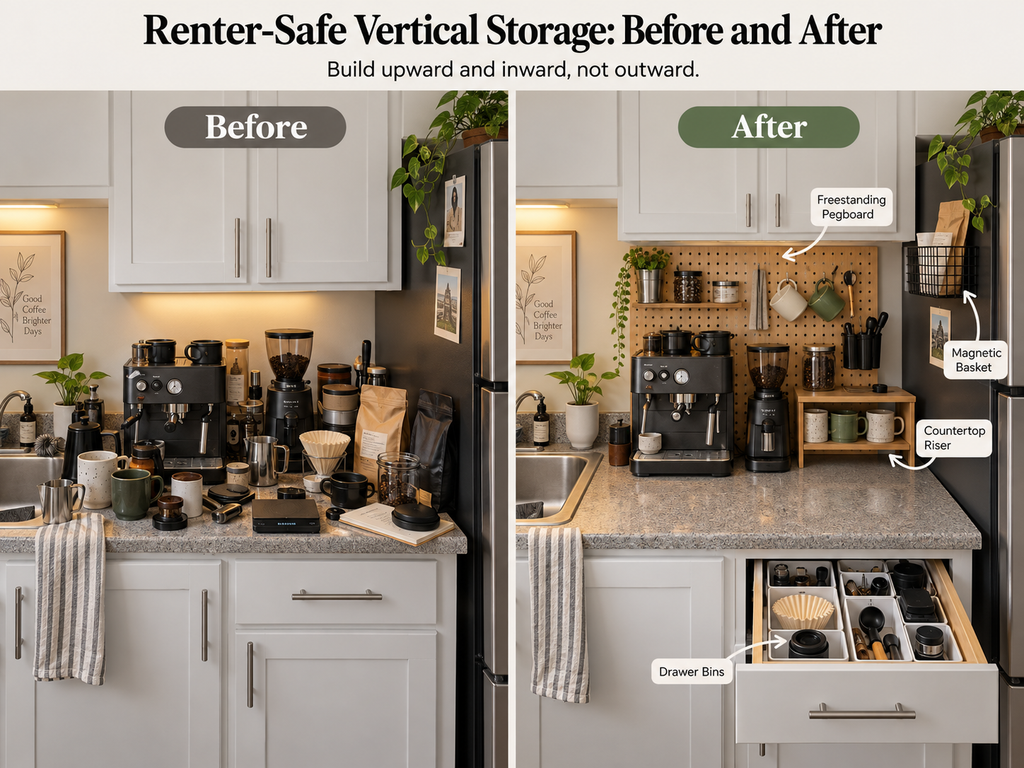
To keep flat surfaces clear, utilize vertical wall space and cabinet interiors. For renters, storage solutions fall into two useful categories: no-drill / generally renter-friendly options and installations that require landlord permission.
Renter Storage Matrix
| No-Drill / Generally Renter-Friendly | Permission or Potential Wall Damage |
|---|---|
| • Countertop shelf risers & trays | • Wall-anchored floating shelves |
| • Freestanding desk pegboards & clamp mounts | • Drilled cabinet grommets or pass-through holes |
| • Heavy-duty rolling utility carts | • Mounted drop-leaf wall tables |
| • Magnetic fridge side-baskets (load-rated) | • Direct wall-drilled mug racks |
| • Tension-rod counter-to-cabinet shelf structures | • Heavy adhesive mounting on delicate plaster or paint |
Renter-Safe Vertical Storage Ideas
- Counter-to-Cabinet Tension Posts: Vertical tension systems mounted between a countertop and the underside of an upper cabinet create multi-tier shelf risers without wall anchors. Use systems specifically rated by the manufacturer for the intended suspended load.
- Freestanding Tabletop Pegboards: Instead of mounting pegboards directly to delicate plaster walls with adhesive strips, opt for freestanding pegboard units with weighted bases or desk-clamp brackets (like IKEA SKÅDIS with connector clamps) to hang scoops, portafilters, and towels.
- Magnetic Refrigerator Storage: Use magnetic baskets or hooks rated for the intended load, and confirm that your refrigerator’s side panel is magnetic before purchasing. These hold milk frothers, thermometers, and bean bags right next to your coffee corner.
- Under-Cabinet & Drawer Organization: Use removable drawer bins, shelf organizers, or freestanding sliding trays inside lower cabinets to keep scales, extra beans, and cleaning brushes organized behind closed doors.
Step 5: Design the Workflow & Finish the Café Look
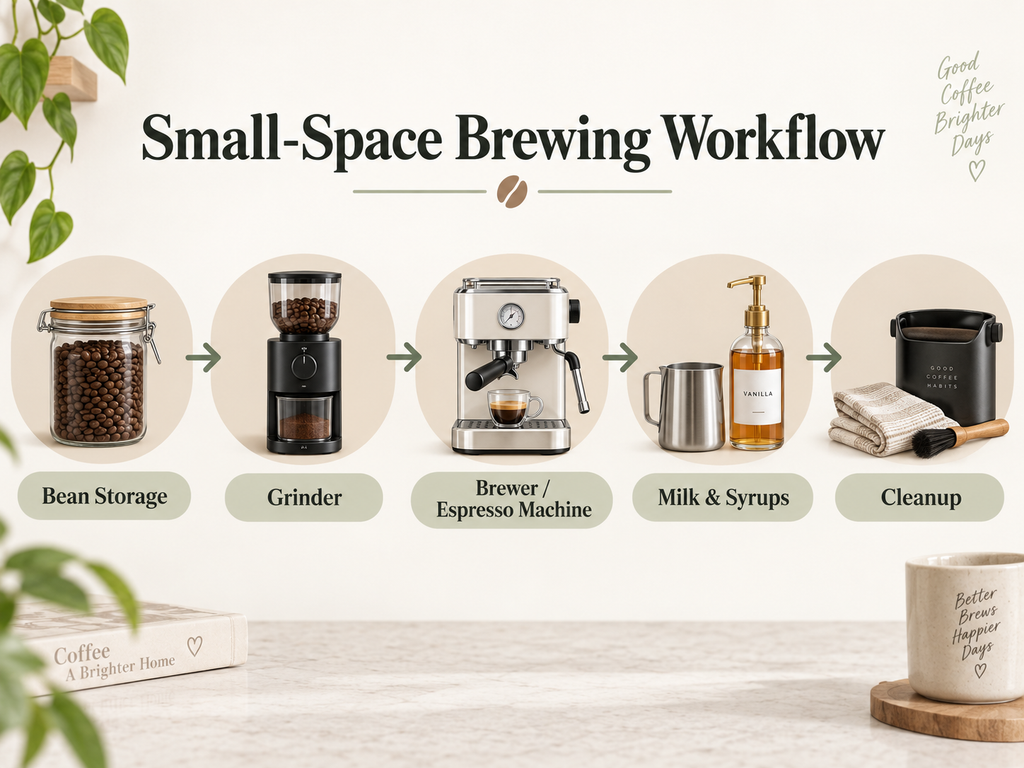
A great home café doesn’t just work well—it feels like an intentional, peaceful morning ritual. Bringing your coffee station to life is as much about atmosphere as it is about organization.
Ergonomic Workflow Mapping
Arrange your tools logically from left to right (or right to left) following the natural brewing sequence:
Bean Storage → Grinder → Brewer / Espresso Machine → Milk & Syrups → Cleanup
Cozy Lighting & Ambiance
- Warm Task Lighting: Install warm (2700K–3000K) LED strip lights under upper cabinets or place a small battery-powered lamp on a cart to create an inviting morning glow.
- Coordinated Containers: Transfer coffee beans into glass or ceramic airtight canisters to reduce visual noise from commercial packaging.
- Aesthetic Menus & Personal Touches: Frame a mini drink menu or write seasonal offerings on a small tabletop chalkboard to give your station an authentic café feel.
The 5-Point Small-Space Coffee Station Checklist
- Zone Measured: Verified counter depth, cabinet height, water tank lift, portafilter swing, and outlet reach.
- Layout Chosen: Selected a countertop tray, rolling cart, hidden pantry, or office nook layout.
- Equipment Right-Sized: Picked a compact brewer (<12″ wide) and space-saving burr grinder matched to your brew method.
- Vertical Storage Active: Used renter-safe shelf risers, magnetic fridge baskets, or freestanding pegboards.
- Workflow & Ambiance Set: Arranged tools in brewing sequence and added warm task lighting.
A functional home café isn’t defined by square footage—it’s defined by creating an intentional, joyful morning ritual in the space you have.