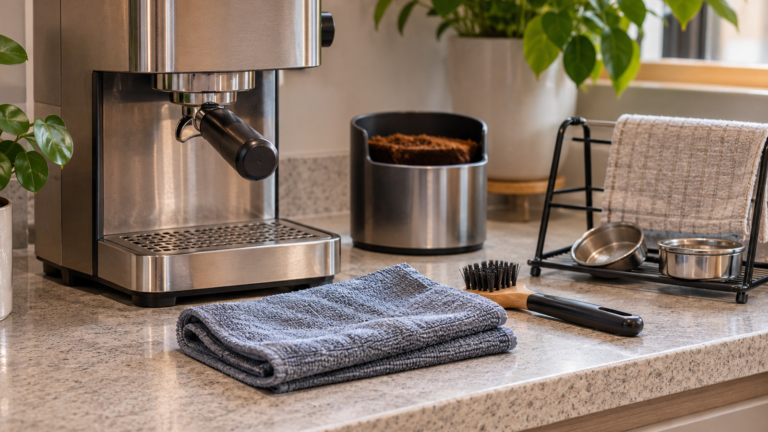
Semi vs. Fully vs. Super-Automatic Espresso Machines: What the Labels Actually Mean for Small Spaces
Choosing an espresso machine for a home café is rarely just a debate about extraction mechanics, pressure profiles, or barista craft. For apartment dwellers, urban kitchen owners, and small-space coffee enthusiasts, the decision almost always comes down to real-world kitchen ergonomics: countertop width, counter depth, cabinet height clearance, accessory clutter, and morning workflow mess.
A common pitfall when designing a compact home coffee corner is assuming that machine width tells the whole story. A portafilter setup may also need room for grinding, preparing the dose and cleaning up, depending on your routine. A bean-to-cup machine combines more tasks in one body, but still needs space to refill beans and water and remove cleaning parts. Compare the equipment and access paths you will actually use, not a fixed accessory list or the machine’s width alone.
This guide evaluates Semi-Automatic / Volumetric Automatic, Integrated / Assisted, and Super-Automatic options through the lens of the small-space home café—focusing on footprint, clearance, maintenance architecture, and daily workflow.
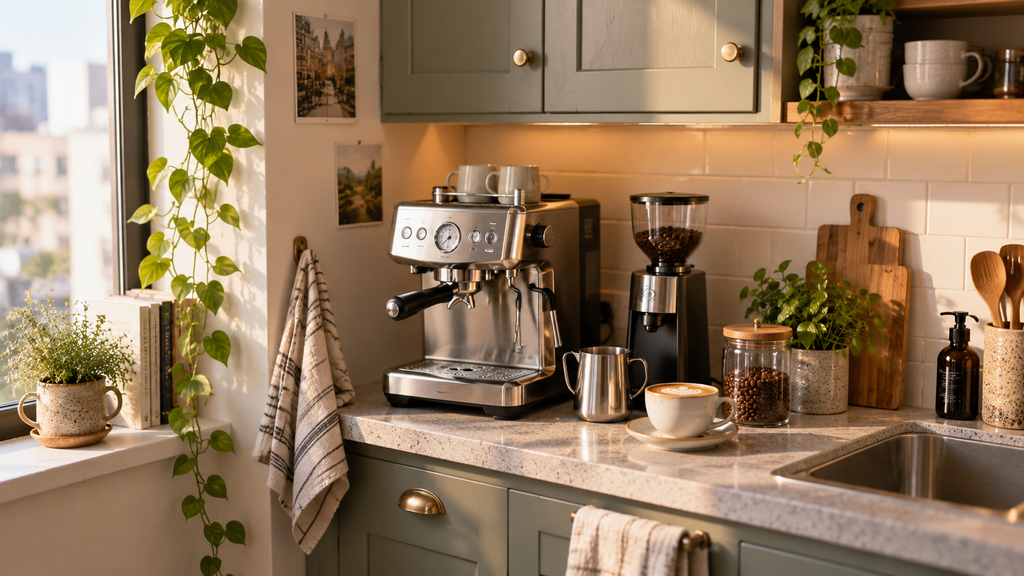
30-Second Quick Answer: Which Setup Fits Your Home Café?
If you need a fast recommendation based on your lifestyle, coffee goals, and kitchen constraints, start here:
| If Your Primary Goal Is… | Recommended Machine Class | What to Expect for Space & Workflow |
|---|---|---|
| Maximum Espresso Control & Quality Potential | Semi-Automatic / Volumetric Automatic Portafilter | Requires maximum total counter space for standalone grinder, scale, tamping mat, and knockbox. Higher daily grounds cleanup. |
| Portafilter Quality with Less Clutter | Integrated / Assisted Portafilter (Hybrid) | Saves horizontal space by combining grinder and brewer into one chassis. Still requires manual portafilter knocking, basket rinsing, and milk jug management. |
| Speed, One-Touch Convenience & Minimal Grounds Mess | Super-Automatic / Fully Automatic Bean-to-Cup | Self-contained single unit with no separate grinder or puck-prep tools required. Requires deeper counter depth and overhead/side clearance for water and bean hoppers. |
| Finding the Smallest Working Footprint | Model-Dependent (Check Depth & Access) | Width alone lies. Compare counter width, counter depth, cabinet height, and operating clearance before buying. |
Demystifying the Labels: Terminology & Machine Classifications
Espresso equipment terminology can be confusing because consumer marketing often diverges from traditional commercial definitions:
- Consumer Marketing Usage: Appliance manufacturers (such as De’Longhi, Philips, and Gaggia) market bean-to-cup models as “fully automatic” or “super-automatic” coffee machines because they automate grinding, dosing, tamping, brewing, and spent puck ejection at the touch of a single button.
- Traditional / Commercial Usage: In specialty coffee definitions, an automatic or volumetric automatic machine refers to a portafilter machine where water flow terminates automatically at a programmed volume, but the user still grinds, doses, and tamps manually.
To avoid confusion, this guide categorizes home espresso equipment into three practical classes:
- Semi-Automatic / Volumetric Automatic Portafilter Machines: Machines requiring manual portafilter prep (grinding, dosing, tamping). Water flow is controlled either manually via a switch or automatically via volumetric push-buttons.
- Integrated / Assisted Portafilter Machines (Hybrids): Portafilter machines that combine a built-in burr grinder and brewing system in one chassis, with models ranging from manual puck preparation to assisted or automated dosing and tamping.
- Super-Automatic / Fully Automatic Bean-to-Cup Machines: Self-contained appliances where an internal motorized brew group handles grinding, dosing, compression, brewing, and spent puck ejection automatically.
Semi-Automatic vs. Integrated vs. Super-Automatic: Quick Comparison
| Feature / Behavior | Semi-Automatic / Volumetric Auto | Integrated / Assisted Hybrid | Super-Automatic / Bean-to-Cup |
|---|---|---|---|
| Grinder Required | External standalone required | Built-in to chassis | Built-in to chassis |
| Puck Preparation | Manual (grind, dose, distribute, tamp) | Manual to assisted/auto-tamped | Internal & fully automated |
| Espresso Control | Greatest direct control over grind, dose, yield, and extraction | High to medium control; built-in parameters | Lower direct control; menu adjustments |
| Milk Texturing Control | Manual steam wand | Manual steam wand or automated frothing | Automated carafe or frother; varies by design |
| Grounds Mess | Highest (stray grounds, tamping dust) | Moderate (contained grinding, manual puck dumping) | Lowest (minimal loose-ground handling) |
| Accessory Space | Highest (grinder, scale, tamping mat, knockbox) | Moderate (scale, milk jug, optional knockbox) | No separate grinder or puck-prep tools |
| Countertop Footprint | Model-dependent linear width | Compact single chassis | Often narrow but deep (16–18 in. depth) |
| Puck Disposal | Manual portafilter knock | Manual portafilter knock | Internal waste container; emptied periodically |
| Milk-System Care | Steam wand wiping & purging | Steam wand wiping/purging or auto-wand | Varies: rinse carafe or run auto-cleaning program |
| Routine Maintenance | Group cleaning, wand care, descaling cycles | Group cleaning, grinder chute care, descaling | User-removable brew group rinse OR sealed tablet cycle |
| Best For | Hands-on hobbyists & coffee purists | Space-conscious baristas wanting portafilter workflow | Minimalist morning rush & one-touch convenience |

Semi-Automatic & Volumetric Automatic Espresso Machines
Semi-automatic and volumetric automatic machines give the user direct control over grind size, dose, distribution, beverage yield, and milk texturing. When paired with an appropriate grinder and a non-pressurized basket, they offer substantial control over espresso texture and extraction density. Illustrative modern double baskets hold roughly 16 to 22 grams of coffee depending on the basket and machine design.
The “Hidden Footprint” of Standalone Setups
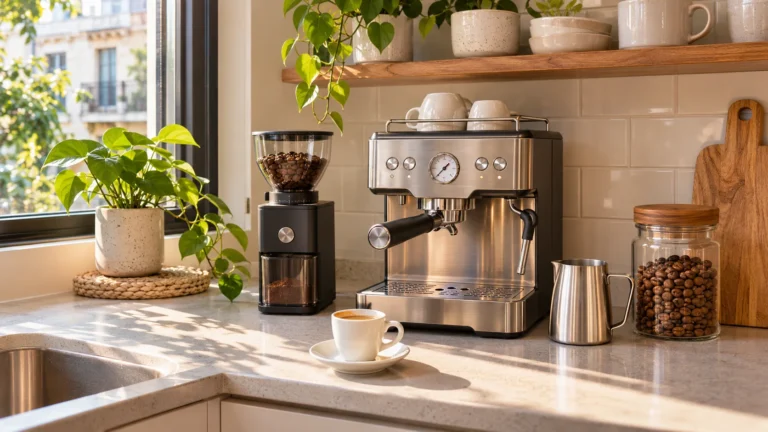
While a compact semi-automatic machine (such as a De’Longhi Dedica or Gaggia Classic Pro) may measure only 6 to 8 inches in width, its actual working footprint is significantly larger:
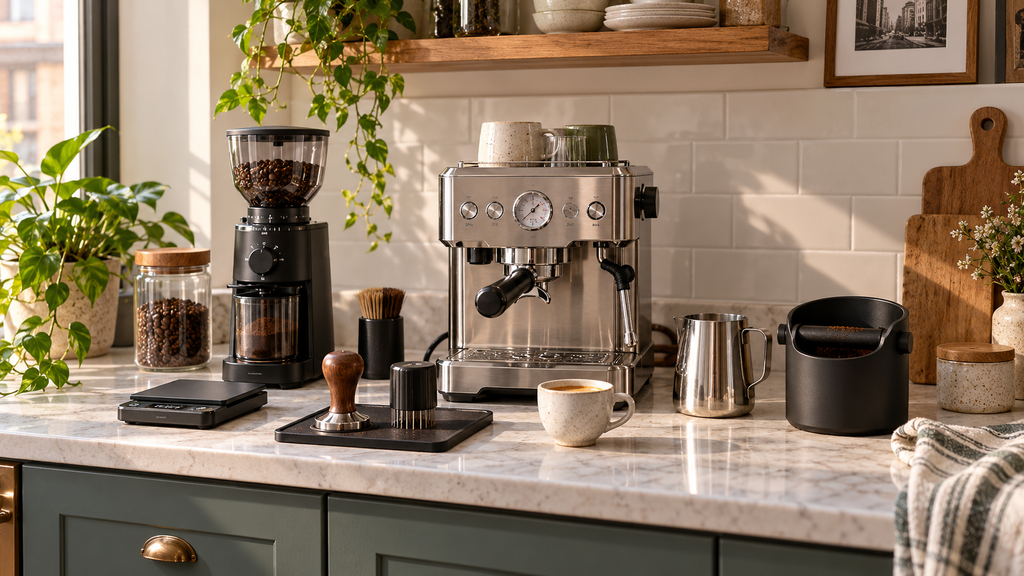
- Equipment and Optional Accessories: If you grind whole beans separately, allow space to use the grinder and prepare the dose. A scale and a suitable tamping surface can help your routine; a separate tamping mat, distribution tool and knockbox are not universal requirements. Include only the tools you will actually use when planning the station.
- Planning the Working Width: A side-by-side machine, grinder and preparation area uses more width than the machine alone. Measure your chosen equipment and rehearse dosing, tamping, brewing and cleanup; there is no single minimum counter width that applies to every semi-automatic setup.
- Workflow & Daily Hygiene: High risk of stray coffee grounds and chaff on the counter. Requires immediate puck knocking, portafilter rinsing, and steam wand wiping/purging after every drink.
Integrated & Assisted Portafilter Hybrids
Integrated machines (such as the Breville Barista Express series, Barista Express Impress, and Oracle Jet) combine an integrated conical or flat burr grinder and brewing system into a single chassis. Models range from manual puck preparation to assisted dosing and automatic tamping.
Space Savings vs. Workflow Realities
- Eliminating Appliance Clutter: By consolidating the grinder and machine, integrated hybrids save considerable horizontal counter width compared to standalone setups.
- Puck Disposal Reality: While integrated hybrids reduce puck-prep clutter, they do not eliminate the portafilter workflow. You still remove the portafilter, knock out the spent puck into a bin or knockbox, rinse the basket, wipe the group head, and manage a milk jug.
Super-Automatic Bean-to-Cup Machines
Super-automatic machines (often called fully automatic or bean-to-cup machines) use an internal motorized brew group. Whole coffee beans are ground, dosed, compressed, and brewed inside the enclosed brew unit at the touch of a button, and the spent puck is automatically ejected into an internal waste container.
Compact Width vs. Deep Counter Depth
Super-automatics are engineered as self-contained appliances, eliminating external grinders, tampers, scales, and knockboxes. However, their spatial requirements differ from portafilter machines:
- Typical Dimensions: Many popular home models measure roughly 9 to 11 inches wide, 17 to 18 inches deep, and 14 to 15 inches high (dimensions vary by model).
- Counter Depth Impact: In compact kitchens, 17 to 18 inches of machine depth—plus clearance for rear power plugs and front drip tray removal—consumes almost the entire depth of a standard 24-inch kitchen counter.
Popular Models & Brand-Specific Maintenance Architectures
Because internal brew groups handle wet coffee grounds out of sight, routine cleaning is essential. Maintenance architecture varies significantly among major manufacturers:
- Philips Removable Brew Groups: The Philips 3200 Series and 2200 Series feature a user-removable brew group that Philips recommends rinsing weekly under warm tap water. Higher-tier Philips LatteGo models (like the 4400 and 5500 series) feature the two-piece, tube-free LatteGo milk system (which cleans in under 10 seconds under a tap) and SilentBrew technology (making the machine 40% quieter than earlier models, certified by Quiet Mark).
- De’Longhi Removable Infusers: Models such as the De’Longhi Dinamica Plus and De’Longhi Magnifica utilize a compact removable infuser that De’Longhi recommends rinsing at least monthly. Innovative designs like the De’Longhi Rivelia include the Bean Switch System with swappable hoppers, allowing users to switch between regular and decaf beans effortlessly in small spaces.
- Gaggia Removable Systems: Compact choices like the Gaggia Brera and premium entries like the Gaggia Accademia feature removable brew groups designed for easy kitchen-sink washing, catering to users who prefer hands-on maintenance.
- JURA Sealed Automated Systems: JURA utilizes a non-user-removable, sealed internal brewing unit (featured in models like the JURA E8). Rather than manual rinsing, JURA machines prompt the user when automated cleaning cycles are required, using manufacturer cleaning tablets to degrease internal lines.
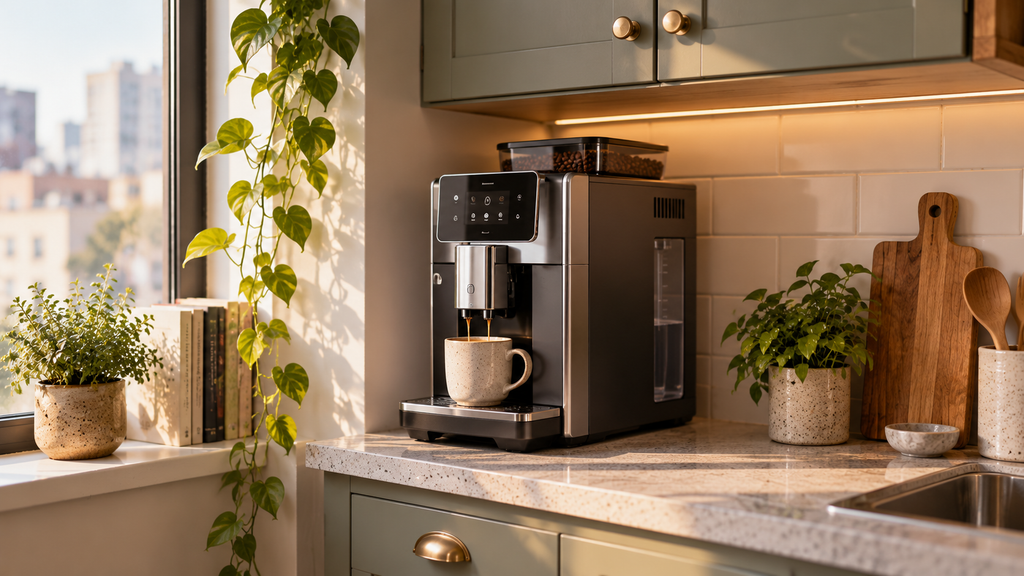
Which Setup Actually Takes Up the Least Space? The 4-Point Spatial Framework
When evaluating a super-automatic or portafilter machine for a small kitchen, evaluating machine width alone is misleading. Instead, analyze your kitchen space across four distinct spatial dimensions:
- Measure Cabinet Height Clearance: Compare available clearance between your countertop and upper cabinets against the machine’s height plus the vertical space needed to open or remove its bean hopper lid and water tank.
- Measure Counter Depth: Compare the machine’s physical depth against your countertop depth (typically 24 inches), ensuring adequate clearance for rear power cords, ventilation, and pulling out the front drip tray or puck container.
- Map Access Direction: Determine whether water tanks, bean hoppers, waste bins, and brew groups open or slide out from the top, side, or front. A machine that fits tightly between two appliances may become unusable if its water tank or service door opens laterally.
- Calculate Total Lateral Footprint: For portafilter setups, add the actual width of your grinder, knockbox, tamping mat, and scale to the machine’s width to determine the true working footprint required.


Buyer Personas: Matching Machine to Lifestyle
1. The Minimalist Morning Rush
- Profile: You want fast, one-touch coffee with minimal manual preparation and grounds cleanup before heading out the door.
- Best Choice: Super-Automatic / Bean-to-Cup Machine.
- Why: A super-automatic machine delivers automated espresso, lattes, and cappuccinos in a single self-contained footprint with no loose coffee grounds handling.
2. The Hands-On Coffee Hobbyist
- Profile: You want maximum control over grind size, dose, yield, puck preparation, and manual milk texturing, viewing coffee prep as a rewarding morning ritual.
- Best Choice: Semi-Automatic / Volumetric Automatic Setup.
- Why: Provides direct control over extraction variables, allowing you to dial in specialty single-origin roast profiles and pour silky microfoam latte art.
3. The Space-Saving Compromise
- Profile: You want the portafilter brewing experience and direct milk-texturing control without cluttering your counter with a standalone grinder and scale.
- Best Choice: Integrated / Assisted Portafilter Hybrid.
- Why: Combines grinding and brewing in one chassis while retaining the hands-on satisfaction of pulling shots with a portafilter.
Small-Space Measurement & Ergonomics Checklist
Before purchasing any home espresso machine or portafilter setup, complete this 5-point kitchen measurement check:
- Measure Cabinet & Hopper Clearance: Measure the exact distance from counter to upper cabinets. Verify machine height with bean hopper lids fully open or removed.
- Check Counter Depth & Rear Clearance: Ensure your counter accommodates machine depth while leaving room for power cord bends, ventilation, and rear access.
- Verify Removal & Service Paths: Test whether you can comfortably remove side water tanks, front puck containers, or internal brew groups without bumping adjacent appliances.
- Account for Prep & Accessory Area: Map out where your scale, milk jug, tamping mat, or knockbox will sit during daily operation.
- Confirm Power & Sink Access: Confirm a suitable grounded outlet is within reach of the power cord and that removable parts (carafes, drip trays, brew groups) easily reach your sink.
Frequently Asked Questions (FAQ)
Q1: Can a super-automatic espresso machine fit comfortably under standard kitchen cabinets?
A: Yes, but you must account for vertical operating clearance, not just static machine height. Many super-automatics require top access to pour coffee beans into the hopper or lift out water reservoirs. Ensure you have adequate headroom under upper cabinets, or select a model with a front-loading water tank and front-accessible bean funnel.
Q2: What is the best coffee to use in a super-automatic espresso machine?
A: The best coffee for super-automatic machines is a fresh, medium to medium-dark roast with a non-oily finish. Extremely dark, oily coffee beans can leave sticky residue on internal ceramic or steel burrs, clogging the built-in grinder and internal brew group over time.
Q3: Do I still need an external knockbox with an integrated espresso machine?
A: Not necessarily. You still need somewhere to dispose of the spent coffee puck after pulling a shot, but that can be a compact tabletop knockbox or a conveniently located trash or compost bin near your coffee station.
Q4: How much side clearance is needed for a super-automatic machine?
A: Check the access direction for each removable part on the exact model. For example, Philips lists the EP3241/54 water tank as front-access, so it needs room in front rather than a sideways tank-removal path. A brew-group service door can need a different access path. Follow the model’s manual for required clearance, and check that adjacent appliances will not block refilling, part removal or servicing.
The Bottom Line
Choosing the right espresso equipment for a small space comes down to how you balance control against convenience and counter space:
- Choose a Semi-Automatic / Volumetric setup if dialing in grind and mastering milk texture is your morning passion, and you have counter space for accessories.
- Choose an Integrated Hybrid if you love portafilter brewing but want a single-chassis footprint.
- Choose a Super-Automatic / Bean-to-Cup machine if speed, one-touch variety, and minimal grounds mess matter most.
Golden Rule: Always measure your complete workflow and access paths—not just machine width!