AeroPress vs French Press for Small Spaces: Brewing, Storage and Cleanup Tradeoffs
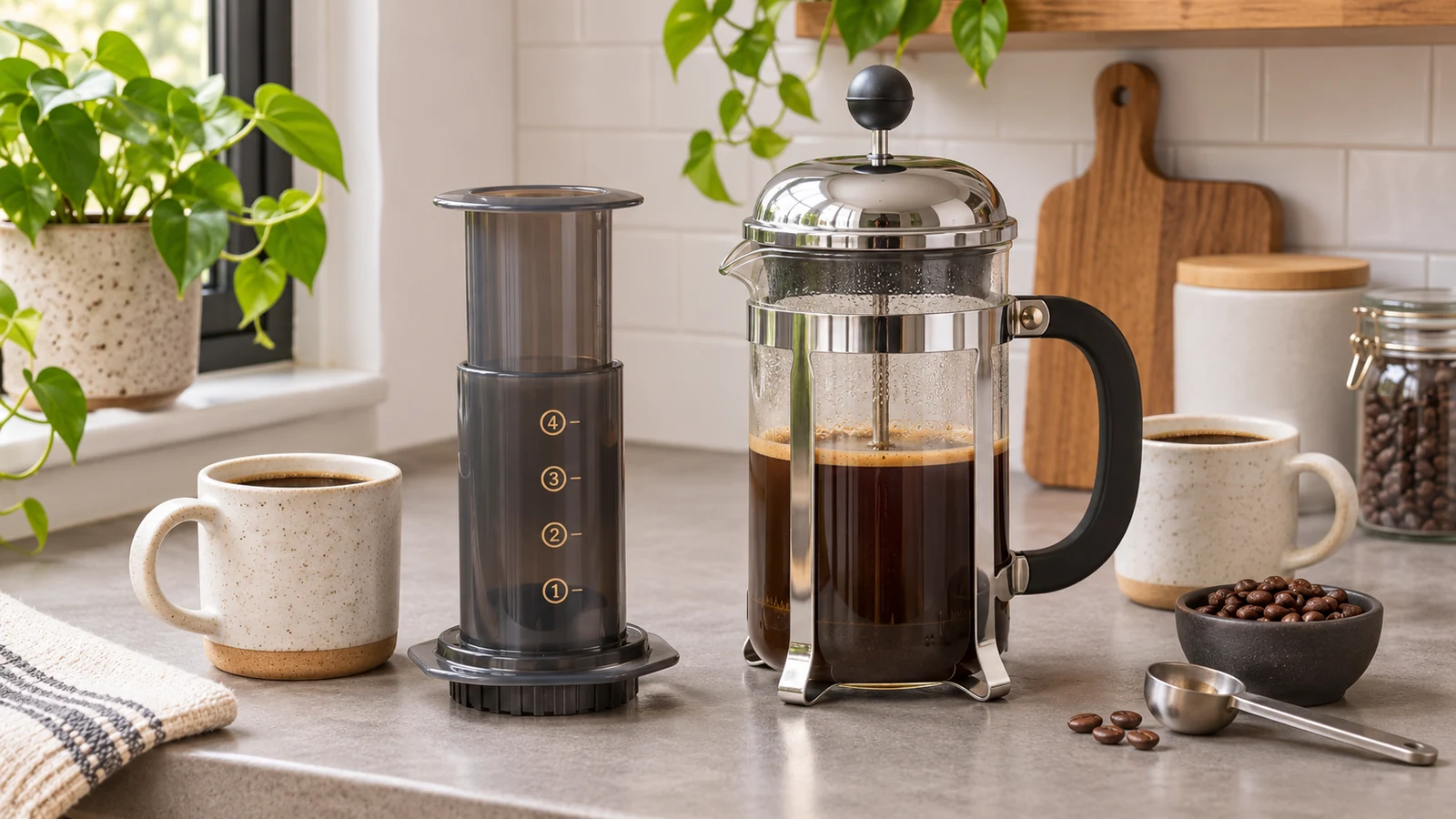
A staged comparison of two manual brewers in a compact kitchen. Conceptual AI-generated image; not a brewing demonstration or a measured fit test.
1. Introduction: Matching Your Brewer to Your Kitchen Constraints
If you are choosing a manual coffee brewer for a small kitchen or studio apartment, start with your primary daily constraint:
- For single-cup brewing, puck-ejection cleanup, and clean paper-filtered coffee that stows away in a drawer: Consider the AeroPress Original (using standard paper microfilters) [F01, F02].
- For a single-cup immersion brewer with a classic metal mesh filter that stays displayed on your counter: Consider the Bodum CHAMBORD 0.35 L (3-cup), provided you inspect the glass before every use and stir strictly with nonmetal utensils [F07, F09].
- For brewing multi-cup batches for two or more people: The Bodum CHAMBORD 1.0 L (8-cup) offers larger vessel capacity, provided your kitchen has sufficient cabinet clearance for plunging and you verify your unit’s safety status under U.S. Recall 27-055 prior to use [F08, SFX01].
In a compact kitchen where counter surface, sink basin room, upper cabinet height, and drying rack space are shared with daily food preparation, a brewer’s physical dimensions tell only part of the story. Evaluating manual coffee equipment requires looking across the complete daily operational routine: preparing grounds, steeping, serving into mugs, disposing of spent waste, washing components, drying parts safely, and stowing the setup away.
This guide evaluates three reference brewer configurations across their complete operational footprints:
- AeroPress Original (Standard Paper Microfilter kit; nominal 10 US fl oz / ~296 mL capacity) [F01, F02].
- Bodum CHAMBORD 0.35 L (Canadian SKU 11170-01; nominal 12 US fl oz / 3 European cups) [F07].
- Bodum CHAMBORD 1.0 L (Canadian SKU 1928-57; nominal 34 US fl oz / 8 European cups) [F08].
2. Model-Qualified Equipment Comparison
The table below details manufacturer-documented specifications, operational fit parameters, and handling characteristics for all three reference brewers. These entries reflect established manufacturer specifications and verified procedural differences rather than laboratory ratings or sensory endorsements.
Table 1: Brewer Specification and Operational Comparison Matrix
| Decision Dimension | AeroPress Original (Standard Paper) | Bodum CHAMBORD 0.35 L (CA 11170-01) | Bodum CHAMBORD 1.0 L (CA 1928-57) |
|---|---|---|---|
| Brewing Mechanism & Filtration | Upright immersion followed by manual air pressure through a disposable paper microfilter [F01, F02]. | Full immersion steeping followed by manual separation via a reusable stainless steel mesh plunger [F07, F09]. | Full immersion steeping followed by manual separation via a reusable stainless steel mesh plunger [F08, F09]. |
| Nominal Manufacturer Capacity | 10 US fl oz (~296 mL); labeled by manufacturer as “1–2 cups” [F01]. | 0.35 L / 12 US fl oz; labeled “3 cups” (~4 US fl oz / 118 mL European cup convention) [F07, F08]. | 1.0 L / 34 US fl oz; labeled “8 cups” (~4 US fl oz / 118 mL European cup convention) [F08]. |
| Finished Household Mug Yield | Unverified net yield. Coffee grounds retain water; net beverage yield is not established by nominal vessel ratings. Compare planned water volume and actual mug capacity [F01]. | Unverified net yield. Suitable for single-cup routines; coffee grounds retain water, so net beverage output is below total nominal vessel volume [F07]. | Unverified net yield. Accommodates multi-cup steeping, but net liquid yield depends on coffee bed retention; no guaranteed mug count [F08]. |
| Chassis Dimensions (W × H × D) | 5.25 in H × 4.2 in W (13.3 × 10.7 cm); operating/plunging envelope unmeasured [F01, F02]. | W 14.0 cm × H 19.0 cm × D 8.0 cm [F07]. | W 17.0 cm × H 24.5 cm × D 10.7 cm [F08]. |
| Use Location & Reach Requirements | Mounted upright on a sturdy mug (70–95 mm inner rim); requires vertical clearance for overhead downward pressing [F02, F03]. | Flat, stable countertop; requires overhead clearance for pulling and lowering plunger [F07, F09]. | Flat, stable countertop; requires overhead clearance for pulling and lowering plunger [F08, F09]. |
| Filtration & Taste Profile | Paper microfilter generally retains more coffee oils and fine particles than metal mesh, yielding a lighter, smoother cup. Clarity varies by grind and recipe [F06]. | Stainless steel mesh permits natural coffee oils and fine micro-grounds to pass, yielding a fuller-bodied, textured cup [F07, F09]. | Stainless steel mesh permits natural coffee oils and fine micro-grounds to pass, yielding a fuller-bodied, textured cup [F08, F09]. |
| Grounds Disposal Route | Remove filter cap safely; press spent paper filter and grounds puck out directly into waste bin [F02]. | Loose wet grounds remain in glass beaker after pouring; requires scooping or straining before washing [F09]. | Loose wet grounds remain in glass beaker after pouring; requires scooping or straining before washing [F09]. |
| After-Use Cleaning Routine | Simple rinse after daily use; periodic washing of silicone seal; top-rack dishwasher safe [F03, F04]. | Wash beaker and mesh assembly according to exact model guidelines; model-specific dishwasher rules remain unverified [F09]. | Wash beaker and mesh assembly according to exact model guidelines; model-specific dishwasher rules remain unverified [F09]. |
| Storage Condition | Store plunger with silicone seal pushed completely through chamber (uncompressed) [F04]. | Store assembled upright on counter or shelf; protect glass beaker from impacts [F07]. | Store assembled upright on counter or shelf; protect glass beaker from impacts [F08]. |
| Critical Safety Controls | Inverted brewing strongly discouraged (burn/instability hazard). Press only into sturdy, compatible mugs [F02, F03, F05]. | Non-shatterproof borosilicate glass. Inspect for chips/cracks before use; avoid metal utensils inside beaker [F07]. (Outside U.S. Recall 27-055 size scope). | Non-shatterproof borosilicate glass. Inspect glass pre-brew. U.S. CPSC Recall 27-055 covers 8-cup glass carafes; avoid metal stirrers & check U.S. spoon/label remedy [F08, SFX01, SFX02]. |
Brewing Mechanism & Filtration
Nominal Manufacturer Capacity
Finished Household Mug Yield
Chassis Dimensions (W × H × D)
Use Location & Reach Requirements
Filtration & Taste Profile
Grounds Disposal Route
After-Use Cleaning Routine
Storage Condition
Critical Safety Controls
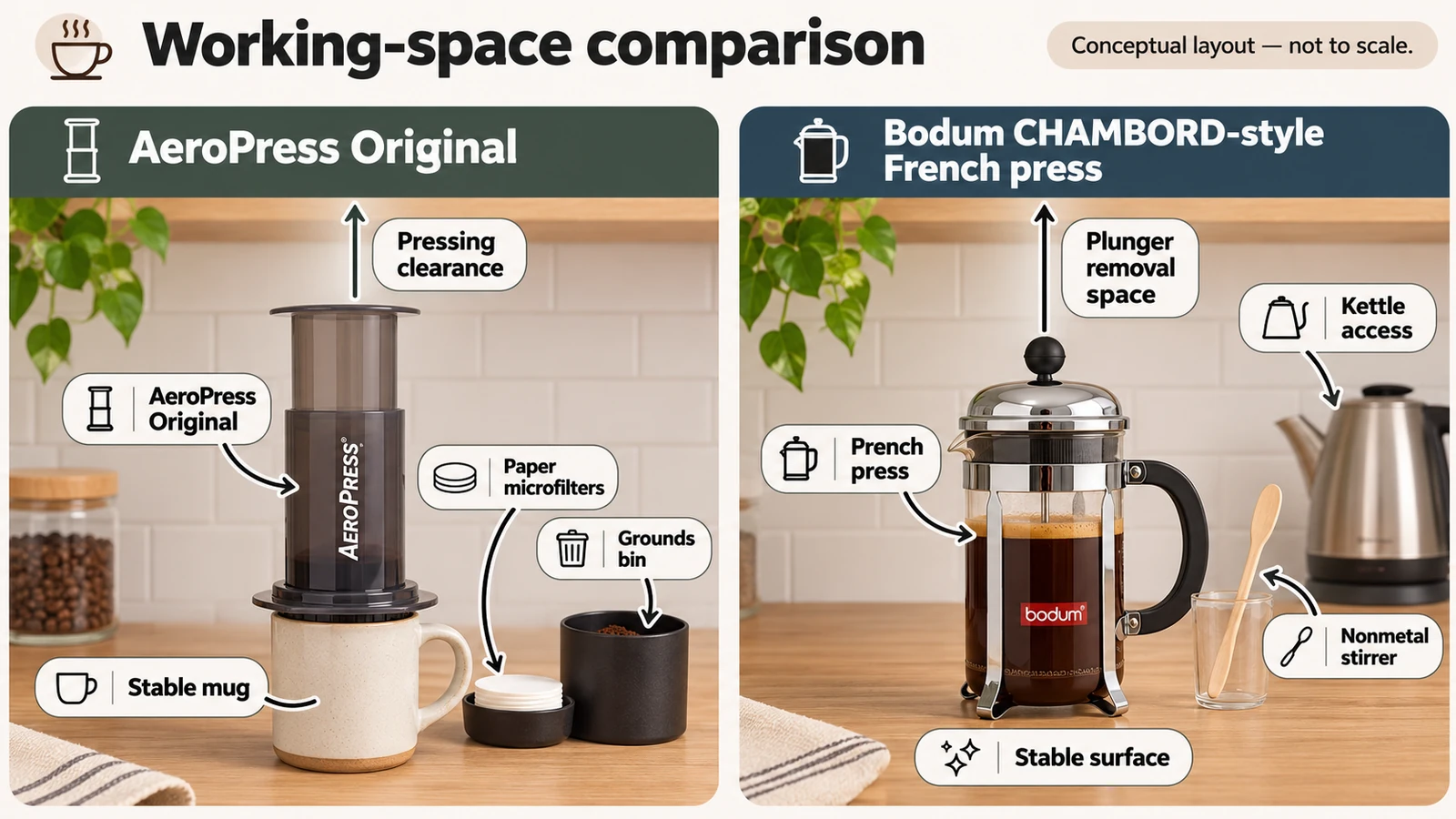
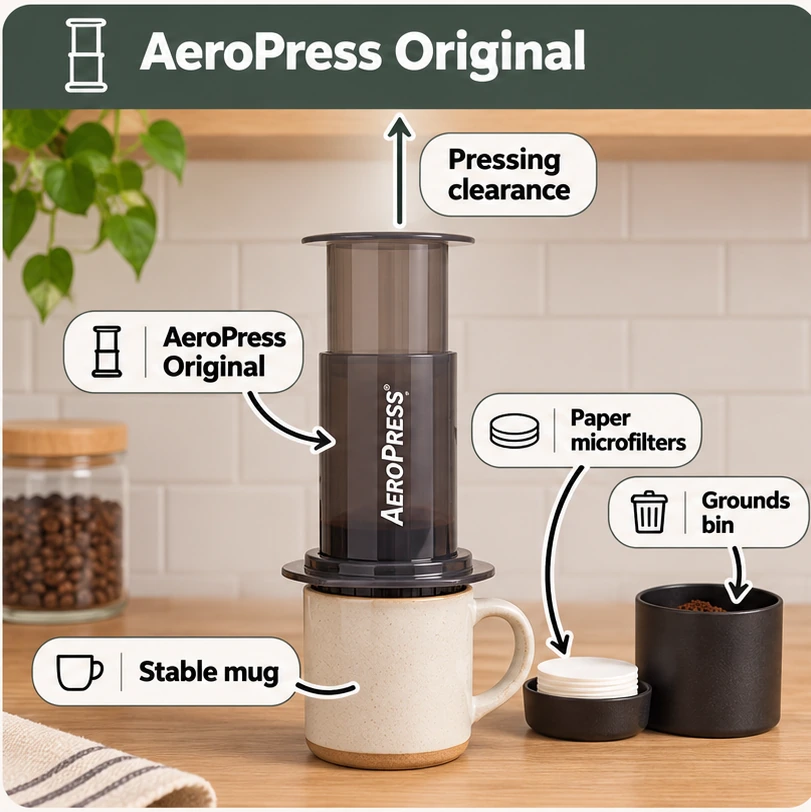
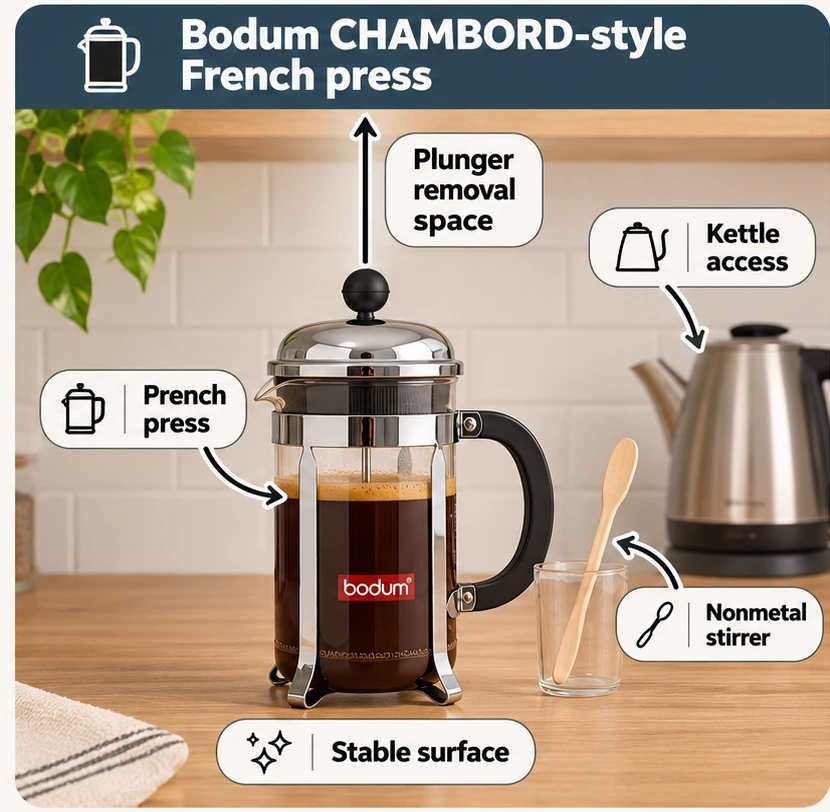
The AeroPress sits on a sturdy compatible mug and needs overhead room for downward pressing, with space nearby for filters and spent grounds. The French press needs a level, stable counter, room to lift out its plunger, access for the kettle and a nonmetal stirring utensil. Measure and check these movements in your own kitchen; the diagram does not establish minimum dimensions or comparative ease.
3. Three Small-Kitchen Operational Scenarios
Kitchen counter layouts and storage arrangements dictate equipment suitability far more than aesthetic preferences alone. Consider how each brewer performs across three common compact-kitchen scenarios:
Scenario 1: The Single-Mug Solo Routine (Counter Surface vs. Cabinet Storage)
- The Environment: A studio apartment kitchen where every square inch of counter space is needed for meal preparation.
- The AeroPress Match: The AeroPress Original works well when counter space must remain completely clear between meals. After brewing and rinsing, the lightweight components can be stowed inside a drawer or cabinet. Storing the plunger with the silicone seal pushed fully through the chamber prevents permanent seal compression [F04].
- The French Press Match: The CHAMBORD 0.35 L offers a compact glass footprint (W 14.0 cm × H 19.0 cm) [F07]. If you prefer keeping a brewer displayed on the counter ready to pour, the 0.35 L press provides a single-cup option without dominating workspace.
Scenario 2: Multi-Cup Household & Entertaining in a Small Space
- The Environment: A compact home where two people drink coffee together, or where guests visit regularly.
- The AeroPress Match: The AeroPress Original has a nominal vessel capacity of 10 US fl oz (~296 mL) [F01]. While concentrated coffee brews can be diluted with hot water to serve two smaller cups, preparing multiple full-volume mugs requires sequential brewing cycles.
- The French Press Match: The CHAMBORD 1.0 L (34 US fl oz nominal capacity) is built for larger batch brewing [F08]. However, net liquid output into mugs depends on coffee bed retention (grounds retain water), so finished beverage volume is less than total vessel capacity, and net mug yield is unmeasured [F08]. Users must account for storing a larger glass vessel (H 24.5 cm) and verifying safety compliance under U.S. Recall 27-055 [SFX01].
Scenario 3: Low Cabinet Heights & Overhead Reach Constraints
- The Environment: A kitchen setup with low-hanging upper cabinets directly above the main countertop work area.
- The AeroPress Match: Pressing an AeroPress requires mounting the chamber onto a sturdy mug and plunging from above [F02]. This downward plunging motion requires adequate vertical arm room. If low upper cabinets block downward shoulder leverage, pressing can become awkward or unsafe.
- The French Press Match: A French press rests flat on the countertop while steeping [F08, F09]. Plunging involves pulling the filter rod upward and gently pushing it straight down [F08]. However, pulling the plunger out also requires vertical clearance. Check overhead cabinet clearance, upward plunger lift, downward pressing reach, and mug stability in your specific kitchen layout.
4. The Seven-Stage Counter-to-Cupboard Workflow
Every manual coffee method moves through seven distinct operational phases. The table below outlines exact step-by-step handling for both systems, emphasizing proper grounds introduction, recipe wait times, and safe handling practices.
Table 2: Seven-Stage Daily Workflow Matrix
| Stage | AeroPress Original (Standard Paper) | Bodum CHAMBORD (0.35 L / 1.0 L) |
|---|---|---|
| 1. Prepare | Place paper microfilter into filter cap and twist onto chamber. Stand chamber upright on a sturdy, heat-resistant mug (top inner diameter 70–95 mm). Add ground coffee to chamber [F02, F03]. | Inspect glass carafe for chips, cracks, or scratches prior to every brew; do not use damaged glass. For a potentially affected 8-cup unit in the U.S., check official CPSC/Bodum recall instructions before brewing. Add coarsely ground coffee into the glass carafe before pouring hot water [F08, F09, SFX01]. |
| 2. Brew | Pour heated water (manufacturer starting points: 80°C / 175°F for dark roasts, 85°C / 185°F for medium/light roasts, or boiling water if using a standard kettle) [F03]. Stir gently for 3 seconds. Insert plunger ~½ inch into chamber top to create a vacuum seal halting drip-through. Wait according to your chosen Original recipe: wait 30 seconds for signature medium-fine grind recipe (or 60 seconds for store-bought medium grind) [F02, F05]. | For the 1.0 L reference model example: add hot water (92–96°C), leaving ~2.5 cm (1 in) headspace. (Note: 0.35 L model-specific brewing parameters remain unverified). Stir gently with a nonmetal (plastic or wooden) spoon—never use metal utensils against glass. Place plunger unit atop carafe with pour spout closed to retain heat. Steep for ~4 minutes [F08, F09, SFX01]. |
| 3. Serve | Apply gentle, constant downward pressure into sturdy mug until hissing sound signals extraction is complete. Do not force plunger [F02]. | Slowly lower the plunger filter assembly without forcing. If resistance occurs, stop pressing. Pour brewed coffee immediately into serving mugs [F08, F09]. |
| 4. Dispose | Remove filter cap carefully (cap is hot). Position brewer over waste bin and press plunger to eject paper filter and spent coffee puck [F02]. | Scoop or strain wet grounds out of beaker into compost/waste bin before washing; avoid flushing large ground volumes down sink drains [F09]. |
| 5. Wash | Rinse chamber, plunger seal, and filter cap under warm water. Top-rack dishwasher safe for Original polypropylene [F03, F04]. | Wash beaker and mesh assembly according to current instructions for your exact CHAMBORD unit; NCA offers general cleaning guidance [F09]. Model-specific dishwasher rules remain unverified. |
| 6. Dry | Set clean polypropylene parts securely on drying rack [F01, F04]. | Place glass beaker and metal plunger components securely on drying rack, ensuring glass is safe from accidental impact [F07, F08]. |
| 7. Store | Store plunger with silicone seal pushed fully through the chamber (uncompressed) to prevent permanent seal deformation [F04]. | Store fully assembled glass press upright on counter or shelf, away from cabinet edges [F07, F08]. |
1. Prepare
2. Brew
3. Serve
4. Dispose
5. Wash
6. Dry
7. Store
5. Five-Question Reader Decision Checklist
Use these five conditional evaluation questions to determine which brewing routine aligns best with your kitchen layout and habits:
Table 3: Reader Decision Checklist
| Decision Question | Conditional Direction | Verification & Safety Checks |
|---|---|---|
| 1. Batch Volume: How much coffee do you brew per cycle? | Single-mug drinkers should evaluate AeroPress Original or CHAMBORD 0.35 L. Multi-cup drinkers should investigate CHAMBORD 1.0 L [F01, F07, F08]. | Measure your actual household mugs. Nominal capacities (10 oz / 12 oz / 34 oz) reflect total vessel fill, not finished mug yields [F01, F08]. |
| 2. Filtration Preference: Crisp body vs. heavy mouthfeel? | If you prefer a lighter, smoother cup with fewer fine particles, select AeroPress with paper microfilters. If you prefer full body and rich oils, select French press [F06, F09]. | Taste characteristics depend on grind consistency, recipe, and brew time; paper microfilters retain more oils while metal mesh permits oil passage [F06, F09]. |
| 3. Waste Routing: Puck ejection vs. wet grounds scooping? | If popping a spent coffee puck directly into a compost or trash bin fits your routine, select AeroPress. If scooping grounds from a beaker works, choose French press [F02, F09]. | Both brewers require rinsing; puck ejection simplifies solids disposal but still requires water rinsing [F02, F04]. |
| 4. Safety & Space: Can you operate the brewer safely? | Check vertical clearance for AeroPress plunging. For French press, inspect glass carafes prior to every brew and avoid metal utensils [F02, F08, SFX01]. | Verify mug rim inner diameter (70–95 mm) for AeroPress. For 8-cup glass presses, review U.S. Recall 27-055 notice; non-U.S. eligibility is unverified [F03, SFX01]. |
| 5. Storage Protocol: Stowed in cabinet vs. ready on counter? | If counter space must remain clear, choose AeroPress for compact stowing. If displaying a ready brewer works, choose CHAMBORD [F04, F07]. | Always store AeroPress seal uncompressed. Store glass carafes securely to avoid accidental shelf impact [F04, F08]. |
1. Batch Volume: How much coffee do you brew per cycle?
2. Filtration Preference: Crisp body vs. heavy mouthfeel?
3. Waste Routing: Puck ejection vs. wet grounds scooping?
4. Safety & Space: Can you operate the brewer safely?
5. Storage Protocol: Stowed in cabinet vs. ready on counter?
6. Actionable Safety & Equipment Handling Guidance
Manual brewing involving boiling water and pressure demands strict adherence to manufacturer safety warnings:
AeroPress Safety Controls
- Upright Plunging & Mug Stability: Always stand the AeroPress Original upright on a sturdy, heat-resistant mug with a top inner rim diameter between 70 mm and 95 mm (2.75 in to 3.75 in) [F03]. Never press into thin-walled glassware, delicate ceramic mugs, or flexible plastic cups [F03].
- Avoid the Inverted Method: The manufacturer strongly discourages brewing upside down (the “inverted method”) [F05]. Inverted brewing creates structural instability, increasing the risk of tipping over and causing severe hot-liquid burns [F05]. To extend steep times safely in the upright position, insert the plunger slightly into the chamber top to create a vacuum seal that halts drip-through [F02, F05].
- Gentle Constant Pressure: Apply smooth, gentle downward pressure into a sturdy mug until the hissing sound signals extraction is complete [F02].
French Press Safety Controls & U.S. Recall Notice
- Pre-Brew Inspection & Utensil Rules: Borosilicate glass carafes are non-shatterproof [F07, F08]. Inspect the glass beaker before every single brew cycle and immediately discontinue using any carafe that exhibits chips, scratches, or cracks [F08, SFX01]. Never use metal spoons or metal utensils to stir grounds inside a glass carafe; metal contact can scratch or weaken the glass, leading to sudden carafe breakage during hot steeping [SFX01].
- U.S. CPSC Recall 27-055 (29 October 2026): In the United States, the Consumer Product Safety Commission issued Recall 27-055 covering approximately 5.9 million Bodum 8-cup and 12-cup French presses with replaceable glass carafes (including the CHAMBORD 1.0 L / 8-cup reference model, SKU 1928-57 in U.S. retailer list AUX01) [SFX01, AUX01]. The recall cites 70 reports of carafe breakage and 48 reports of burns [SFX01]. Affected U.S. consumers are instructed to stop using metal stirring utensils immediately, refrain from using damaged carafes, and contact Bodum USA for a free plastic stirring spoon and warning label [SFX01, SFX02].
- Geographic & Size Qualifications: The smaller CHAMBORD 0.35 L (3-cup) model is outside the stated 8-cup/12-cup size scope of U.S. Recall 27-055 [SFX01]. Applicability of the U.S. recall remedy to Canadian-sold units (such as item 1928-57) or international markets (UK, AU, NZ) is unverified and open. Consumers outside the U.S. should consult Bodum and local regulatory authorities regarding unit eligibility [SFX02].
7. Reader Conclusion: Summary of Small-Kitchen Tradeoffs
Choosing between the AeroPress Original and a Bodum CHAMBORD French press comes down to how your daily brewing routine interacts with your physical kitchen constraints:
- Select the AeroPress Original if you brew single cups, want puck-ejection waste routing, prefer a lighter cup filtered through paper microfilters, and plan to stow your brewer in a drawer between uses (storing the silicone seal uncompressed).
- Select the CHAMBORD 0.35 L if you brew single cups and prefer a classic metal-mesh immersion brew that stays displayed on your counter, provided you inspect the glass carafe before every use and stir strictly with nonmetal utensils.
- Consider the CHAMBORD 1.0 L if you regularly brew multi-cup batches for two or more people, provided your kitchen has sufficient vertical clearance for plunging and you verify your specific unit’s safety status under U.S. Recall 27-055 prior to use.
Before purchasing or brewing, measure your mug inner diameters (70–95 mm for AeroPress), verify your upper cabinet clearance, and establish a safe waste and drying routine that fits your countertop layout.