How to Choose a Home Espresso Machine for the Routine You Want
A machine can fit neatly in a product photo and still be awkward to use every morning. Before you fall for a polished steel case or a long menu of drinks, think about what happens between opening the coffee beans and clearing the counter afterward.
Do you want to grind and tamp each shot yourself? Would you rather keep the grinder and espresso machine in one appliance? Or would you prefer to choose a drink on a screen and leave more of the brewing steps to the machine?
Those are three different ways to make espresso at home. None is best for every kitchen or coffee drinker. This guide helps you choose the workflow first, then check whether a particular machine will fit your space, budget and willingness to clean it.
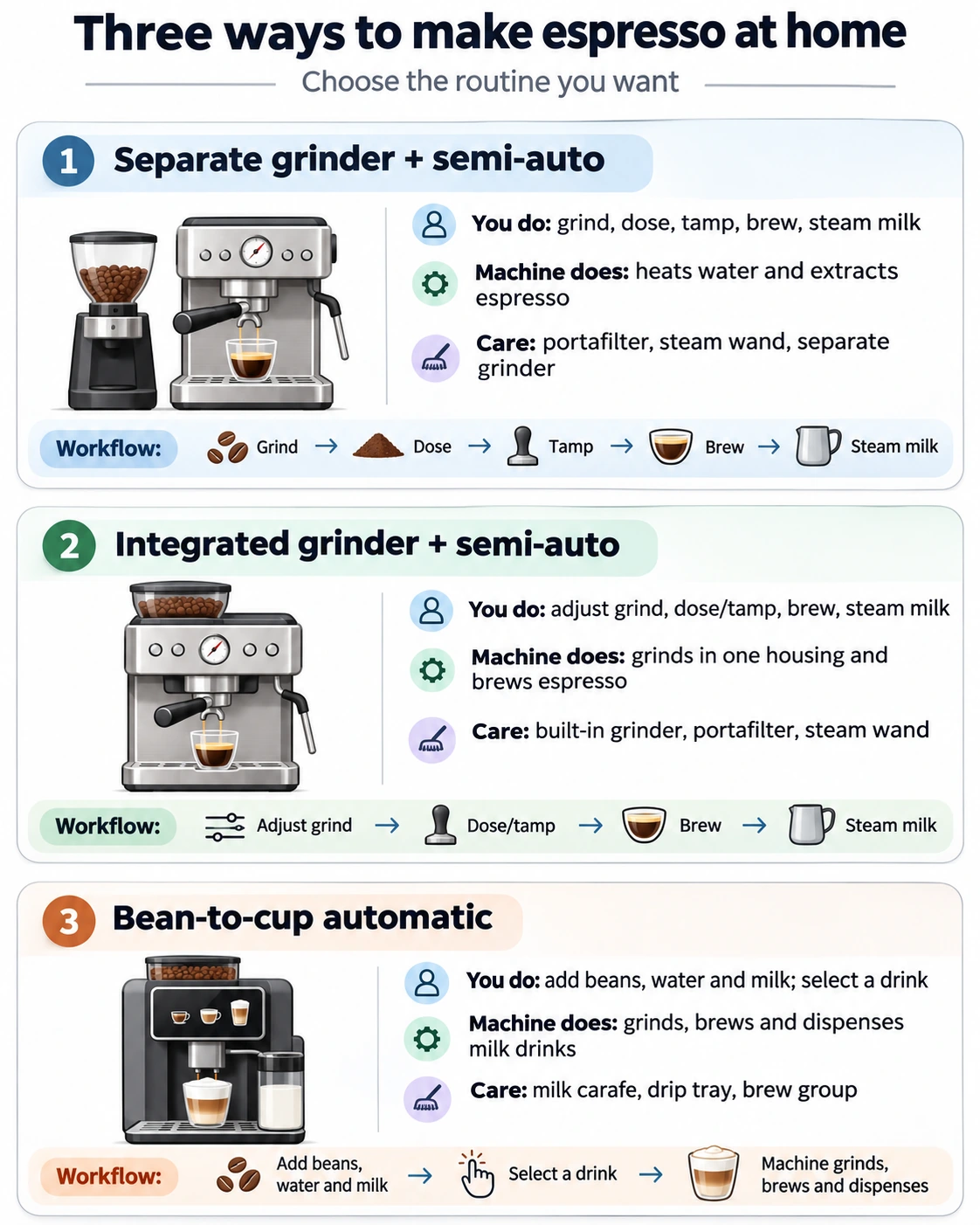
Three ways to make espresso at home
Start here. These are workflow categories, not ranked winners or a complete list of every machine type. The named models later in the guide are manufacturer-documented examples, not machines we have personally tested.
Workflow
Separate grinder + semi-auto
What you do: Grind, dose, tamp; brew and steam milk
What the machine does: Heats water and extracts under your control
Care that remains: Portafilter, steam wand and separate grinder
Integrated grinder + semi-auto
What you do: Adjust grind and dose; tamp, brew and steam
What the machine does: Grinds in one housing and brews
Care that remains: Steam wand, portafilter and built-in grinder
Bean-to-cup automatic
What you do: Manage beans, water and milk; select a drink
What the machine does: Grinds, brews and dispenses milk on supported programs
Care that remains: Milk carafe, drip tray and brew-group care
The deciding question is not simply “Which machine has more features?” It is “Which steps am I willing to repeat on an ordinary morning?” The answer may change when you make milk drinks, share the machine with other people or need your counter for cooking.
Five decisions to make before you buy
1. How hands-on do you want to be?
With a semi-automatic espresso machine, you normally prepare the coffee in a portafilter and take part in the extraction process. A built-in grinder reduces the number of separate appliances, but it does not necessarily do the tamping or steam the milk. A bean-to-cup machine takes over more of the preparation, while leaving you responsible for ingredients, refilling and cleaning.
If adjusting the grind and learning the process sounds enjoyable, manual steps may be part of the appeal. If you would rather select a drink and move on, start with the automatic path. Neither preference says anything about how sophisticated your taste is.
2. What do you drink most often?
A morning espresso and a daily latte create different routines. A manual steam wand adds a task: fill the jug, texture the milk, then wipe and purge the wand according to the machine instructions. An automatic milk system takes over the dispensing, but its carafe and milk circuit still need care.
Think about the drink you actually make on a typical weekday, not every recipe you might try once. That will tell you more about the useful features than a long menu of rarely chosen drinks.
3. What space must remain usable?
Do not judge the setup by the machine’s quoted width alone. You may need space beside it to turn a portafilter, a place to set down a cup or milk jug, room to lift a water tank or bean-hopper lid, and clearance to remove a milk carafe or drip tray. A separate grinder also needs somewhere to live.
Measure your own counter and check the exact model’s refill, cleaning and operating access. Some manufacturer listings differ in how they label width and depth, so this guide deliberately does not rank the examples by a disputed dimension. Our compact-espresso guide goes deeper into complete working space rather than housing measurements.
4. Do you already have a grinder?
A separate grinder can be selected, serviced or replaced independently from the espresso machine. That flexibility matters if you already own one or expect to change your setup later. The tradeoff is another component to position and keep clean.
An integrated-grinder semi-automatic keeps grinding and brewing in one housing, but you still need to adjust the grinder and prepare the coffee bed. A bean-to-cup machine also includes its own grinding system, with maintenance requirements that depend on the specific model. None of these arrangements, by itself, proves better-tasting espresso.
5. What is the full cost of the routine?
The machine price is not the whole setup price. Depending on your choice, you might also need an espresso-capable grinder, a scale, suitable baskets or tamping tools, a milk jug, water-treatment supplies and the cleaning materials specified in the manual. Some accessories are included with particular packages; others are not.
Check the actual box contents and replacement-supply costs in your country before comparing totals. Product prices and bundles change, so an undated price range would give you false precision. If your main constraint is money, use a complete-setup budget comparison rather than choosing by machine price alone.
Three machines that show the difference
These examples illustrate the paths above. They are not a verdict that a particular model beats every competitor. The product descriptions below come from manufacturer specifications and instructions for identified North American or Canadian models; confirm the version actually sold in your market.
Path A: Breville Bambino BES450 — keep grinding separate
The Bambino is a semi-automatic espresso machine with a manual steam wand and a portafilter. If you use whole beans, you pair it with a separate espresso-capable grinder. You grind, dose and tamp the coffee, lock in the portafilter, start the extraction and steam milk yourself when you want it. Breville’s Canadian specification page describes one- and two-shot controls and a 54 mm portafilter. [1]
This path makes sense when you want to learn the hands-on routine or prefer to choose the grinder independently. It is less attractive if the extra grinder takes over space you cannot spare or if tamping and milk steaming are chores you do not want.
Breville advertises a three-second ThermoJet warm-up to extraction temperature. That is a heater claim, not a measurement of how long it takes to grind, brew and clean up. Also, the Bambino is not the Bambino Plus: do not assume they have identical milk features, accessories or dimensions. The precise contents of the purchased package should be checked against its current listing and manual. [1]
After milk use, the steam wand needs the care described in the manual, and you still need to manage the portafilter, baskets and drip tray. A small appliance body does not mean a no-work routine.
Path B: Breville Barista Express BES870 — grinder and machine together
The Barista Express incorporates a burr grinder into the espresso-machine housing. Its current Canadian product listing describes 16 grind settings and grinding directly into a 54 mm portafilter. You still decide how to prepare the shot, tamp the coffee and use the manual steam wand. The machine has not turned semi-automatic brewing into one-button coffee. [2]
This is a sensible path to consider when you want hands-on espresso without buying a separate grinder appliance. Having the grinder inside the machine may simplify what sits on the counter, but it does not remove the need to learn grind settings or clean the burrs, portafilter and wand.
The important exception: if you already have a capable grinder, the integrated one may duplicate equipment you own. And if the grinder becomes the part you want to replace later, its built-in arrangement gives you a different upgrade decision from a separate grinder. Those are practical ownership tradeoffs, not measured differences in flavor.
Before ordering, check the dimensions for the exact product revision and market version, including the space needed to operate, refill and clean it. If manufacturer listings conflict, ask the manufacturer to resolve the discrepancy rather than choosing the smaller dimensions.
Path C: Gaggia Magenta Prestige RI8702 — choose the drink, maintain the system
The Gaggia Magenta Prestige is a bean-to-cup machine with an integrated grinder, a drink-selection interface and a milk carafe that dispenses milk for supported recipes. That changes the morning routine: instead of preparing every portafilter shot and steaming each jug yourself, you select the drink and let the machine carry out more of the preparation. Gaggia’s current North American listing describes these features. [3]
The convenience has a second half. The milk carafe and brew group are removable because they need cleaning and maintenance. Gaggia’s North American instructions describe quick milk-system cleaning after use and regular carafe and brew-group care. The exact steps and products depend on the unit and its manual. [4]
This path is worth considering if you want repeatable menu-driven preparation, especially for milk drinks, and are willing to follow the maintenance routine. It is a weaker fit if you prefer tinkering with every stage of extraction or strongly dislike dismantling and cleaning milk-contact parts.
Gaggia’s current North American listing advertises a menu that includes over-ice options, while older descriptions of the Magenta Prestige show a different number of drinks. Check the exact variant and menu rather than relying on a universal recipe count. Automatic brewing is not the same thing as maintenance-free brewing.
Try a one-morning test before choosing
You do not need a stopwatch or a product ranking to decide which workflow appeals to you. Imagine making your usual drink tomorrow and trace the same five checkpoints for each machine type.
1. Beans: Will you weigh and grind them separately, fill an integrated hopper, or manage the bean supply inside an automatic machine?
2. Brewing: Do you want to dose, tamp and pull the shot, or select a programmed drink?
3. Milk: Will you use a steam wand, an automatic carafe, or no milk system at all?
4. Clearing up: Which parts must be rinsed, wiped, emptied or disassembled after that drink?
5. Returning the counter to normal: Where will the grinder, milk jug, accessories and used grounds go?
Now mark the step you would most like to avoid—and the one you would enjoy doing. If the most annoying step is grinding and tamping, a fully automatic machine may change your experience more than an upgraded steam wand. If cleaning milk hardware is your least favorite task, automatic milk dispensing may not be the uncomplicated choice you first expected. This is a decision exercise, not a claim that one workflow saves a measured number of minutes.
When the obvious choice might be wrong
A separate grinder can still be the simpler purchase
If you already have a suitable grinder, a semi-automatic without another built-in grinder may be easier to justify. You are keeping the machine and grinding decisions separate, though the two pieces still need their own room.
An integrated grinder does not make espresso automatic
A single housing can be visually tidy and still involve manual dosing, tamping, milk work and cleanup. Choose it because you want that combined setup, not because the product description makes it sound hands-free.
The automatic option may trade preparation steps for cleaning steps
A milk carafe saves you from manually texturing every jug, but regular cleaning is not optional. If you rarely drink milk beverages, consider whether you need that feature at all. For a reader who enjoys pressure and technique as a hobby, a manual-lever machine may be a separate specialist route rather than one of these three everyday categories.
What to verify before you buy
Use this short check for the exact model and country you are purchasing in:
□ The model or SKU matches the current manufacturer instructions, including local voltage and warranty.
□ The included grinder, portafilter, baskets, milk jug and cleaning supplies are clear; no essential part is assumed to be in the box.
□ The counter leaves room to refill, brew, steam, remove the carafe or brew group, and empty the drip tray.
□ The manual’s after-use and periodic cleaning steps are tasks you are willing to do.
□ The total purchase covers accessories and continuing supplies, not just the machine.
□ Any price, dimension or feature you use to decide belongs to the exact revision offered by your retailer.
If you have a particularly narrow kitchen, continue with our Compact Espresso Machines guide for operating-space checks. For the cost of a complete station, see the Budget Home Espresso Setups guide. If your main question is which grinder to buy, see Choosing a Grinder for a Compact Home Café. And if the words “semi-automatic” and “super-automatic” are still confusing, our machine-labels guide explains the terms in more detail.
The most useful outcome is not a universal winner. It is knowing which parts of espresso preparation you want to do yourself, which you would rather delegate to a machine, and what it will take to keep that choice working on your counter.
How this guide was researched
This is a research-based workflow comparison, not a hands-on test or a ranked tasting review. Product examples and operating distinctions are drawn from the manufacturers’ published descriptions and instructions; those statements were not independently benchmarked for flavor, noise, speed or longevity. Features, accessories and cleaning requirements may differ by region and revision. Check the manual and supplied parts for the exact model before purchasing.
[1] Breville, Bambino BES450: Canadian product information https://www.breville.com/en-ca/product/bes450 ; US/Canada instruction manual https://assets.breville.com/BES450/BES450_USCM_IB_M26_LR.pdf
[2] Breville, Barista Express BES870: Canadian product information https://www.breville.com/en-ca/product/BES870 ; US/Canada instruction manual https://assets.breville.com/BES870/BES870_USCM_IB_X26_LR.pdf
[3] Gaggia North America, Magenta Prestige product description and specifications: https://www.gaggia-na.com/collections/super-automatic-espresso-machines/products/gaggia-magenta-prestige
[4] Gaggia, Magenta Prestige RI8702: official manual index https://www.gaggia.com/product-search/ri8702-01-magenta-prestige/ ; North American 120V English/French instruction manual (Rev. 00, October 2024) https://www.gaggia.com/app/uploads/2024/10/6420-010-21247-MAN.-GAG.MAGENTA-PRESTIGE-120V-EN-FR-Rev-00.pdf . Confirm the booklet and machine revision supplied in your market.