How to Store Coffee Beans in a Small Apartment
When counter space is limited and cabinet storage is precious, another container needs to earn its place. You can store whole-bean coffee well without building a coffee bar or buying a specialist canister. Start with a reliable seal, a cool, dry, shaded storage spot, and an amount of coffee that matches how often you brew. Air, moisture, heat and light are the main storage concerns identified in the National Coffee Association’s storage guidance.
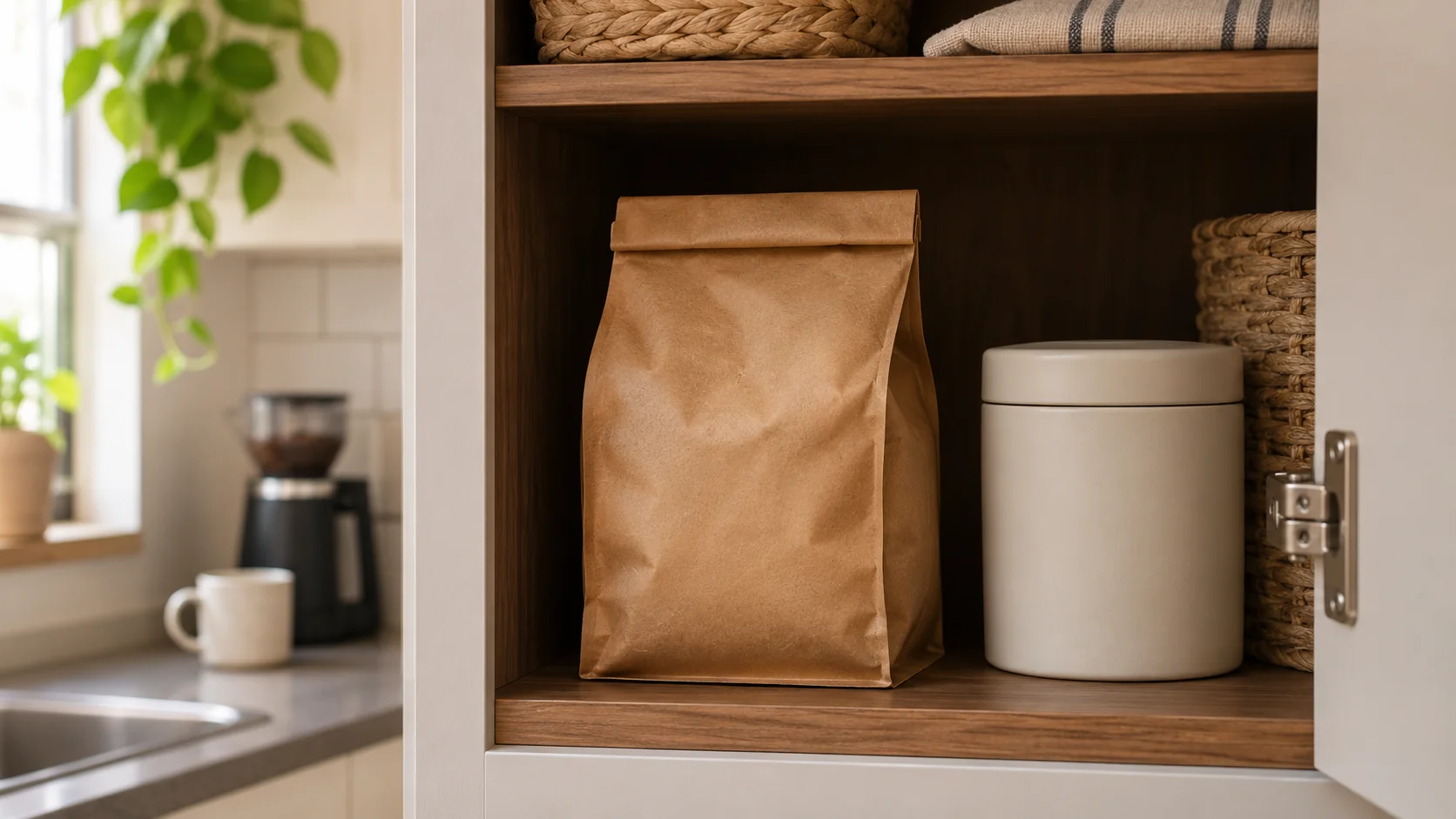
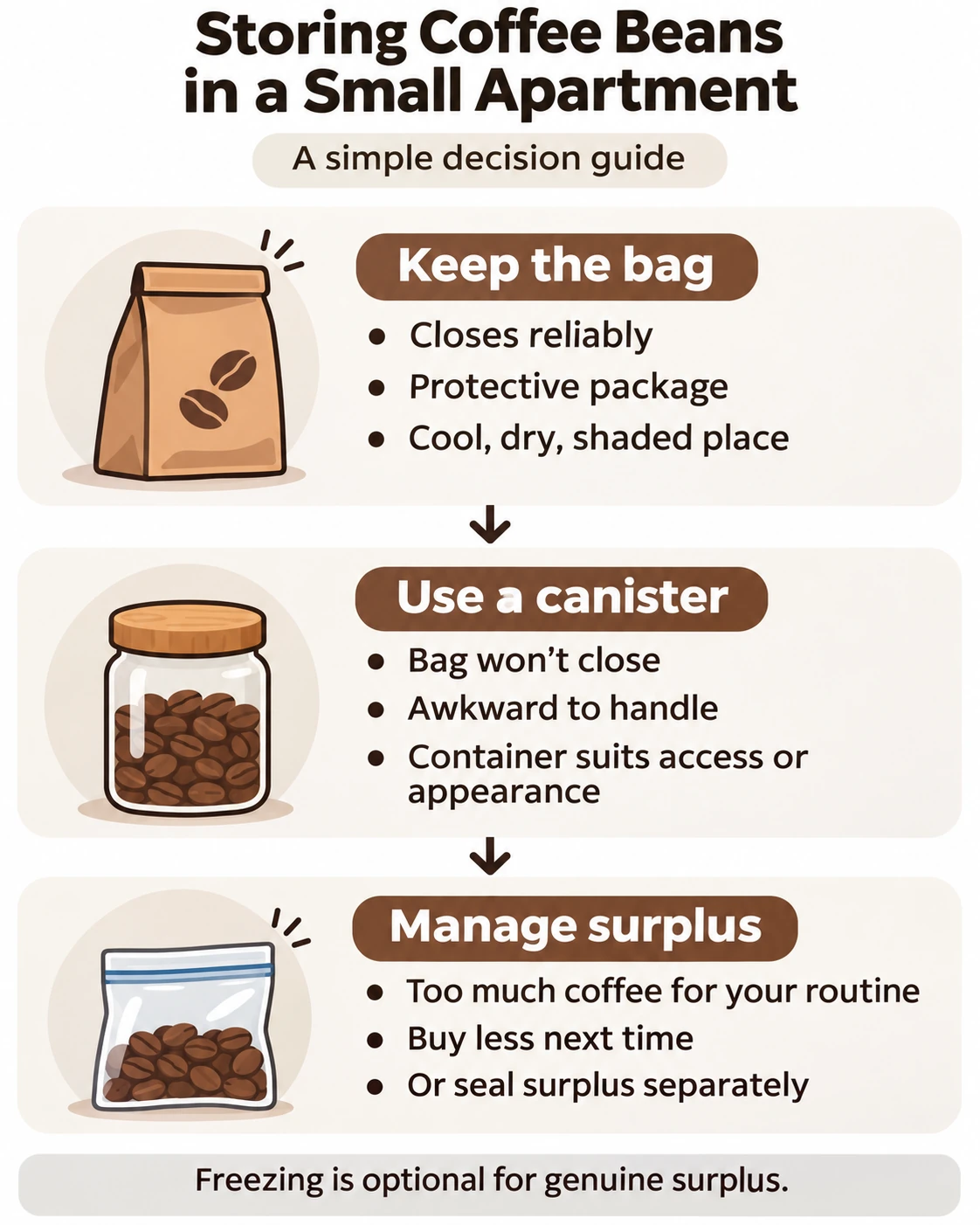
If your roaster bag closes reliably and protects its contents, keeping the beans in that bag can be a sensible small-kitchen choice. A separate canister may be better when the bag will not close properly, is awkward to use, or when a reusable container makes the daily routine easier. Neither choice wins in every kitchen.
Where Should You Store Coffee Beans in a Small Apartment?
Look for a cupboard or drawer that stays reasonably cool and dry, out of direct sunlight and away from frequent heat or steam. A cabinet beside an oven or dishwasher may get warmer than one farther away. If you like a clear glass jar, keeping it inside a shaded cupboard offers a way to enjoy the container without leaving the beans exposed to direct light. The National Coffee Association recommends dark, cool storage and protection from air, moisture, heat and light.
For beans you open every day, an ordinary suitable cupboard is usually simpler than the refrigerator. The National Coffee Association notes differing views on chilling coffee: moisture and food odors are concerns, and condensation may form when a cold container meets warmer, humid air. The risk depends on the conditions, not on every refrigerator opening having the same result.
You can keep the arrangement simple by separating two jobs:
- Active supply: the closed bag or canister you use now, in an accessible shaded cupboard or drawer near your brewing area.
- Reserve supply: unopened bags or securely sealed surplus stored away from cooking heat and dampness. If you genuinely need longer storage, freezing is an optional reserve strategy discussed below.
These are practical location choices, not a requirement to own only one kind of coffee or dedicate a whole shelf to beans.
Keep the Original Bag or Move Beans to a Canister?
The National Coffee Association generally recommends transferring coffee from retail packaging into an airtight, opaque container, particularly when the original packaging is poor for storage. But a well-closing roaster bag can also be practical. The useful question is whether the package you actually have seals reliably and fits the way you use your kitchen.
Keep the original bag when its closure works, its material provides suitable protection, and you can put it away after each use. Make sure the closure is fully shut; a printed valve or zipper by itself does not guarantee a good seal.
Use a food-safe, airtight container when the bag is torn, cannot be resealed, is difficult to handle, or when a container is worth the storage space for access or appearance. An opaque container can be left in a suitable spot; a clear one can be kept in a dark cupboard. You do not need a ranked or expensive vacuum-canister model to make this decision.
One experiment helps explain why “always decant” is too simple. Smrke and colleagues (2022) compared four specific post-opening treatments: an integrated screw-cap package, the original bag closed with a clip, the bag closed with tape, and beans transferred to an airtight metal canister. The screw-cap design performed best on the study’s GC/MS chemical aroma-freshness indicators. This was not a consumer tasting test, and it does not show that ordinary zip bags outperform every type of canister.
The practical tradeoff is therefore about the reliability of your particular closure, the storage conditions, and the effort of using it—not a universal laboratory ranking of bags against jars.
How Much Coffee Should You Buy at Once?
Smaller purchases can reduce the time a bag sits open between brews; the National Coffee Association recommends buying in manageable batches. The right amount depends on your own routine, though, not on a universal day when coffee suddenly stops tasting good.
Required purchase mass = grams per brew × brews per day × days between purchases.
Worked Purchase Calculation
Suppose you use 15 g for each brew, make one brew per day, and plan to buy coffee every 14 days. These are illustrative inputs, not a prescribed recipe or a scientifically established freshness window.
15 g/brew × 1 brew/day × 14 days = 210 g required.
If one available bag contains 200 g, that covers 13 complete 15 g brews (195 g), with 5 g left—too little for the fourteenth brew. A 250 g bag would leave 40 g after exactly fourteen such brews. Either pack size might be workable with a different buying schedule; compare the available sizes with your actual usage and how much surplus you are comfortable keeping.
Copyable Coffee Buying and Rotation Worksheet
Copy these prompts into a note or print them. They are a planning template, not interactive fields or a coffee-expiry calculator.
Calculate your next purchase
- Grams per brew: ______ g
- Brews per day: ______
- Your chosen days between purchases: ______
- Estimated grams needed (multiply the three entries): ______ g
- Available package size you plan to buy: ______ g
Check your storage setup
- Does the current bag close reliably? ______
- Active-supply location (cool, dry, shaded): ______
- Reserve plan (none, unopened bag, or appropriately sealed surplus): ______
Record your rotation
- Roast date, if provided: ______
- Date the bag was opened: ______
- Your next planned purchase date: ______
Should Coffee Beans Go in the Freezer or Fridge?
For frequently used coffee, refrigeration adds moisture and odor concerns, and the National Coffee Association notes that advice about refrigeration and freezing differs. Keeping the active supply well closed in an appropriate cupboard is a straightforward starting point. Freezing becomes more relevant when you have genuine surplus that you cannot reasonably use soon.
There is some direct evidence for freezer storage under particular conditions. Cotter and Hopfer (2018) had 48 consumers smell freshly ground coffee from whole beans stored for nine weeks, comparing frozen samples, room-temperature samples and a freshly roasted control. For the dark roast tested, frozen samples were perceived as more similar in aroma to the fresh control than room-temperature samples. The study did not test brewed-cup taste, every roast or package type, or a universal storage deadline.
If you choose to freeze surplus, use packaging that closes well and limits moisture and odor exposure. Smaller portions can make it easier to avoid repeatedly opening the entire reserve. In a Specialty Coffee Association lecture, researcher Samo Smrke recommends leaving a frozen package sealed while it warms before opening, as a precaution against condensation on cold beans exposed to humid air. The ideal handling depends on the package and conditions; that lecture does not establish an exact thawing time or a universal ban on taking a package in and out of the freezer.
Freshness, Staling, and Signs to Stop Using Beans
Coffee changes after roasting: carbon dioxide escapes, aroma compounds diminish, and an older bag may give a less vivid cup. The SCA freshness lecture distinguishes physical degassing from chemical aroma changes. Declining flavor is a quality issue; age or a flatter taste alone does not establish whether coffee is safe or unsafe. There is no single date on which all roasted beans suddenly become unpalatable.
If beans are visibly moldy or have become wet and appear contaminated, discard them rather than trying to brew them. Appearance and smell can prompt caution, but neither provides a complete food-safety test. The National Coffee Association distinguishes typical quality decline from mold-related concerns in damp storage.
When Is a Storage Canister Worth Its Space?
Before adding another item to a small kitchen, check three things: does your current bag close reliably, is there a suitable shaded place to keep it, and does your purchase amount fit the brewing routine you chose? If those answers work, keeping the bag is reasonable. If a canister makes access, handling or appearance meaningfully better, it may earn its space even when the original bag is intact. And if the problem is simply too much coffee, buying less—or handling genuine surplus separately—may be the more useful change.
Sources
National Coffee Association — Storage and shelf life.
Specialty Coffee Association — Samo Smrke, The Science of Coffee Freshness (2019 Expo lecture).